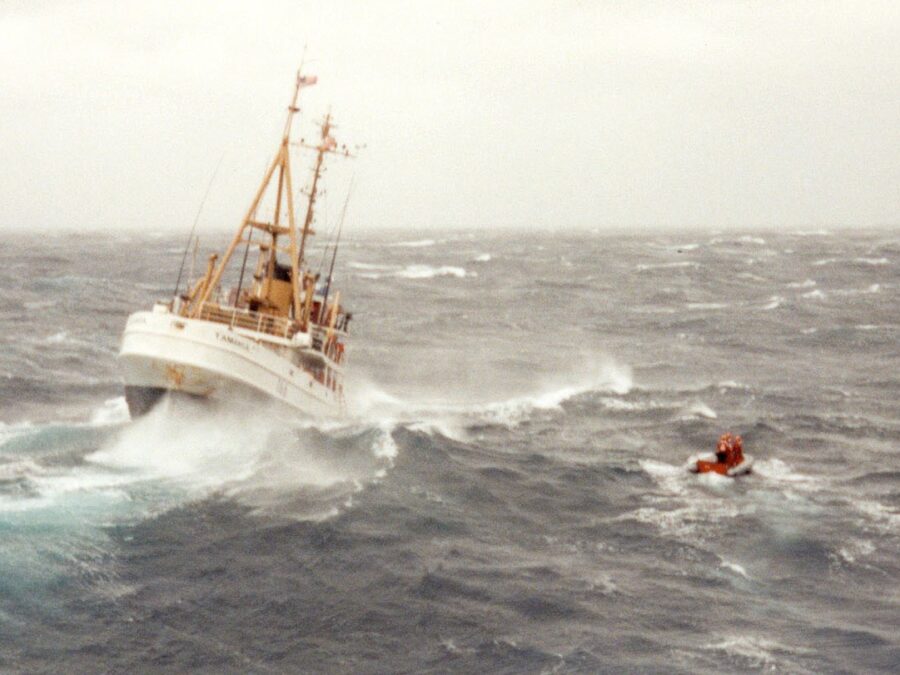
This year marks the 35th anniversary of “The Perfect Storm,” also known as the “Halloween Nor’easter” because it struck in late October 1991. It was the third major weather event to hit the East Coast in an unusually active month.
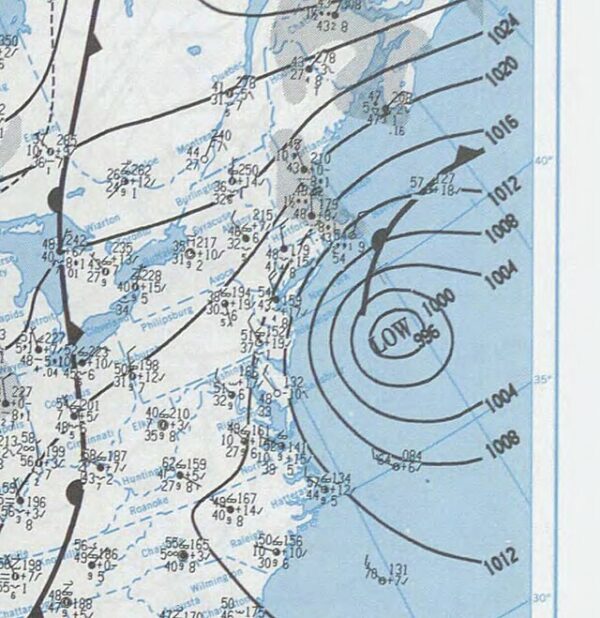
By Oct. 28, two large weather systems collided off the East Coast. Hurricane Grace formed on Oct. 27 and was moving from the southeast on course for an unnamed extra-tropical cyclone. The two weather systems spawned a much larger and more powerful storm.
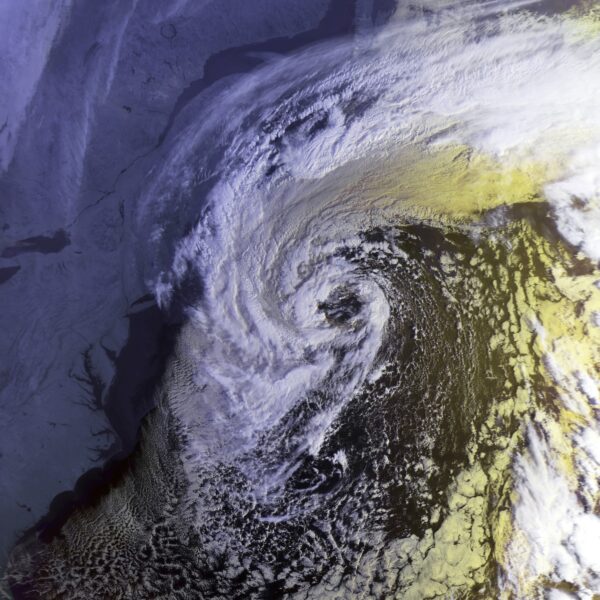
By Oct. 30, NOAA data buoys reported sustained winds of over 60 miles per hour with gusts well over 70, and waves as high as 40 feet.
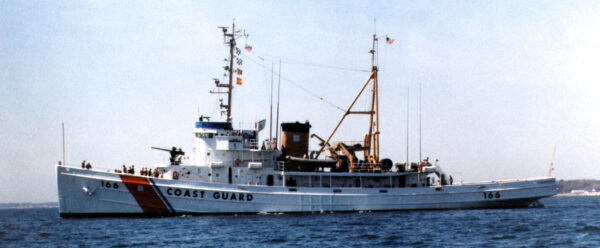
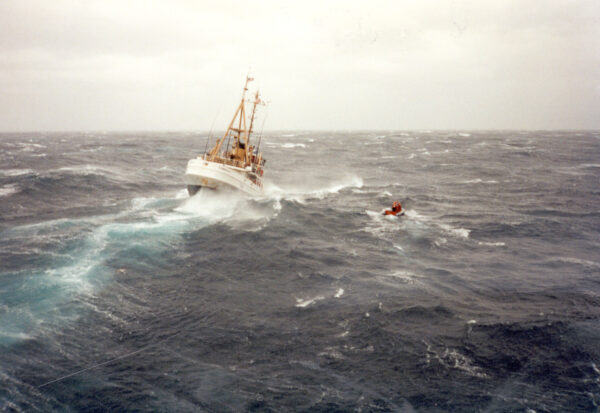
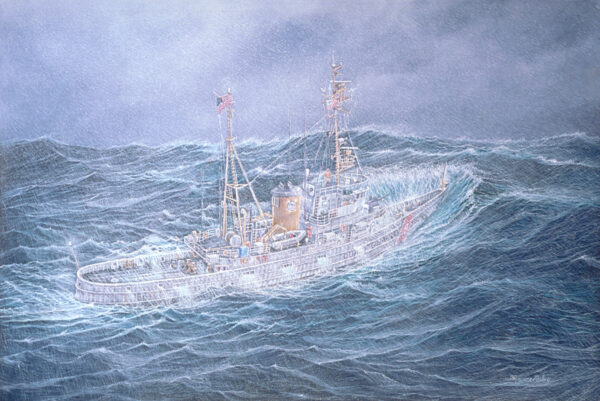
In 1991, the World War II vintage medium-endurance cutter Tamaroa (WMEC-166) was nearly 50 years old. Her search and rescue operations during the infamous Perfect Storm make for an amazing story. Built by the U.S. Navy in 1943 as seagoing tug USS Zuni for towing damaged battleships, Tamaroa relied on a single screw. She had a seaworthy design and a relatively high freeboard of 10 feet, but her World War II crew nicknamed her the “Automatic Trough Finder.” In 1946, the Coast Guard received this surplus Navy vessel into the fleet, and, by the time of the storm, she was celebrating nearly fifty years of service.
The 32-foot sailboat Satori served not only as a yacht, but also as a home for her owner and he invited two experienced sailors to help sail her from Portsmouth, New Hampshire, to Bermuda. The three sailed into the middle of the storm and, at around midnight on Oct. 29, a freighter relayed Satori’s first distress calls to Boston’s Coast Guard District One command center. Not long after the calls came in, an HU-25 Guardian Falcon Jet from Coast Guard Air Station Cape Cod located Satori. As day broke, Coast Guard HH-3F Pelican helicopters and HU-25 jets flew cover in shifts until Tamaroa could slug her way through the brutal seas.
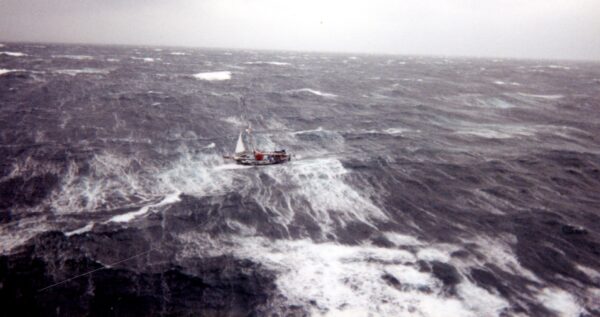
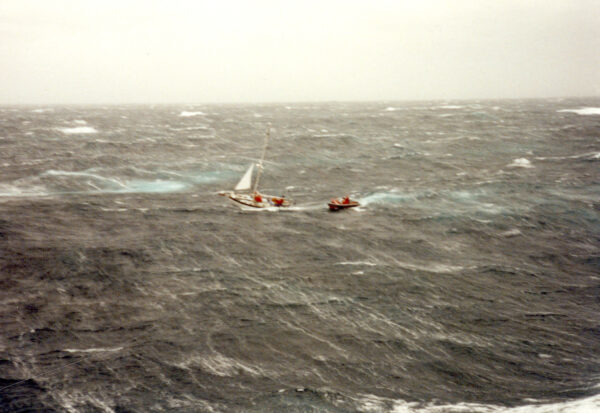
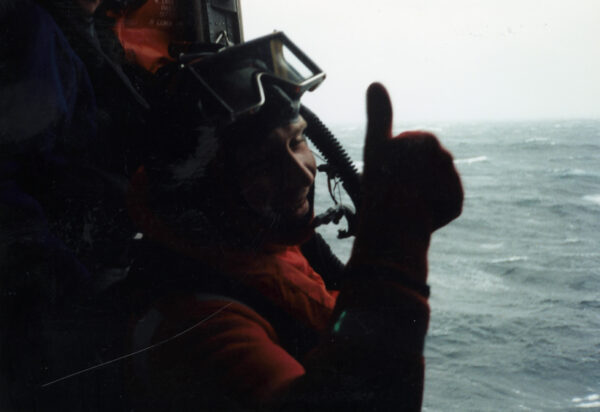
Around midday, the Coast Guard assets assembled for Satori including a Coast Guard jet flying cover; an H-3 hovering overhead; and the nearby Tam, now standing by and experiencing nerve-wracking 90-degree rolls. After the District One commander determined Satori’s voyage “manifestly unsafe,” Tamaroa’s captain, Cmdr. Larry Brudnicki, ordered an evacuation of the sailboat using Tam’s rigid-hulled inflatable boat (RHIB). The seas proved insurmountable for the RHIB, so the hovering H-3 deployed its rescue swimmer to avoid the danger posed to its hoist cable by Satori’s wildly swinging mast. Satori’s crew entered the water, and, with the assistance of the rescue swimmer, the process took less than 20 minutes. After an hour’s flight back to Air Station Cape Cod, the H-3 touched down safely with all three of Satori’s crew.
Not long after the Satori rescue, Tamaroa had to alter course and render assistance yet again. This time, a New York Air National Guard HH-60 helicopter returning from its own storm-related mission, ran low on fuel, could not connect with its C-130 fuel tanker and had to ditch 90 miles south of Montauk, New York. Another Falcon jet took off from Cape Cod and flew a circular “sector” search with a 20-mile radius around the H-60’s last known position. The jet’s commander had brought along night-vision goggles allowing his crew to see the downed helicopter crew’s emergency strobes and to vector in a Coast Guard H-3 helicopter.
Unfortunately, wind speeds now reached 100 miles per hour and attempts to use the rescue hoist failed because the wind blew the basket too close to the helicopter’s tail rotor. Again, the Tamaroa would prove the storm victims’ best chance for survival.
After a four-hour transit from Satori’s evacuation site, Tamaroa arrived near the downed airmen. The state of the sea and winds had worsened with the cutter rolling through an arc of 110 degrees; and the World War II tug’s gunwales, which ordinarily stood ten feet above the water, swung from even with the water level to 20 feet above it. Brudnicki looked out from the bridge to see wave tops towering over the ship. Green water regularly swept Tamaroa’s deck, swamping her deck crew. Meanwhile, the engineering crew worked feverishly to keep the 50-year-old powerplant running; a breakdown during this critical point, especially with only one screw, would prove disastrous. With the National Guard aircrew fighting for their lives in the roiling water, Brudnicki tried several times to position the cutter upsea of the men and drift down on them for the rescue. After two hours, Tamaroa succeeded in maneuvering next to the hypothermic aircrew while the deck gang dropped a “scramble net” over the cutter’s side. By pulling the net up in sync with the cutter’s severe roll, the Tamaroa’s crew retrieved one airman and then pulled up a group of three others. The downed H-60’s pararescueman, Rick Smith, was never found despite a massive search effort later mounted to locate him.
Among the many other response efforts mounted during the 1991 “Perfect Storm,” these operations demonstrated the importance of employing aviation and sea-going assets together to get the job done. In the evacuation of the Satori, the sea state prevented Tamaroa from extricating the crew from the sailboat, but it took only minutes for an H-3 helicopter to evacuate them from the water. In the rescue of the Air National Guard helicopter crew, the men of the Tamaroa overcame extreme weather conditions to retrieve the airmen from the mountainous seas. In both cases, these Coast Guardsmen overcame technological and environmental obstacles and met the challenges head-on with resourcefulness, resilience and adaptability.
In recognition of Tamaroa’s achievements in the Perfect Storm, the cutter received the Coast Guard Unit Commendation and the Coast Guard Foundation Award. In addition, many of the crew received the Air Force Commendation Medal and 18 of Tamaroa’s crew received the Coast Guard Medal, the largest group recognition in the history of that service award. The crew of the Tamaroa demonstrated without a doubt the ability of Coast Guard personnel to use the assets at hand, no matter the age and obsolescence, to get the job done. They were members of the long blue line and served in the highest traditions of the United States Coast Guard.
Tamaroa’s Coast Guard Unit Commendation reads as follows:
The Commandant of the Coast Guard takes pleasure in presenting the COAST GUARD UNIT COMMENDATION to:
USCGC TAMAROA (WMEC 166)
NEW CASTLE, NEW HAMPSHIREfor service as set forth in the following
CITATION:
“For exceptionally meritorious service from 29 October 1991 to 2 November 1991 while engaged in search and rescue operations during a severe winter storm which ravaged the Northeast United States. USCGC TAMAROA (WMEC 166) encountered seas up to 30 feet and winds in excess of 50 knots while responding to a distress onboard the sailing vessel SATORI. HH-3F CG1493 was unable to hoist the three people and took up station and watched as TAMAROA launched its own rescue effort. TAMAROA’s Rigid Hull Inflatable (RHI), damaged by the severe sea conditions during the launch was able to pass mustang suits to the SATORI crew. When SATORI’s bow came crashing down on the RHI, the small boat rescue was no longer possible. SATORI’s crew was led to the water and hoisted by CG1493. The crew of the RHI also had to be hoisted from the water due to the damage their boat sustained. While pounding north through the relentless seas, TAMAROA was diverted to assist an Air National Guard HH-60 helicopter which had been forced to ditch at sea, due to fuel exhaustion, some 90 nautical miles south of Montauk, New York. With the seas now in excess of 40 feet and winds gusting more than 80 knots, TAMAROA steamed the 15 miles in five hours. HU-25 CG2116, already on scene, sighted four men in the water fighting for their lives in the mountainous waves. CG1493 tried for 43 minutes to recover the four survivors, but the rescue basket simply blew straight back in the 60 to 70 knot winds. TAMAROA made eight approaches on the men for two hours as wave after wave crashed over the ship. The first man was brought aboard using scramble nets, eventually the other three were rescued in the same manner. TAMAROA’s use of the winds and seas to recover the four men was an extraordinary effort given the 50 degree rolls, the heavy seas and 60 plus knots of wind. The valiant rescue efforts pushed TAMAROA, its crew and the air crews to the limits of endurance. The professionalism and devotion to duty exhibited by TAMAROA are in keeping with the highest traditions of the United States Coast Guard.”
The Operational Distinguishing Device is authorized.
For the Commandant,
PAUL A. WELLING
Vice Adm., U.S. Coast Guard
Commander, Coast Guard Atlantic Area
National Coast Guard Museum insider tip: The Museum will display original items from the Tamaroa, including the ensign flown by the cutter during its harrowing rescues during the “Perfect Storm” in 1991, in the Aviation and Motor Lifeboat Rescue Timeline in the Lifesavers Around the Globe wing.
About the Author(s)