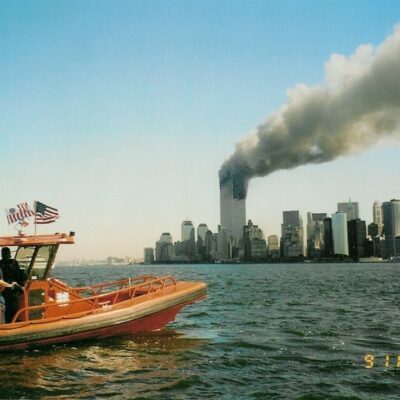
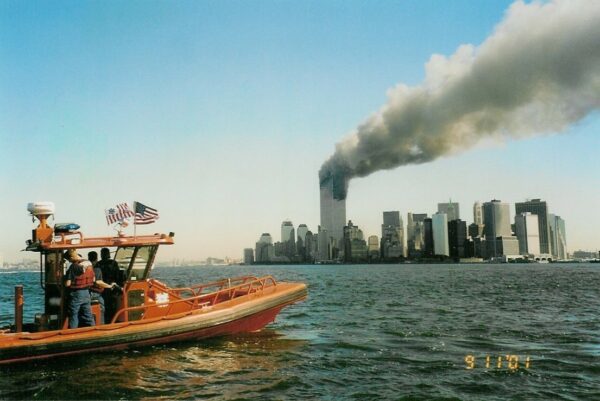
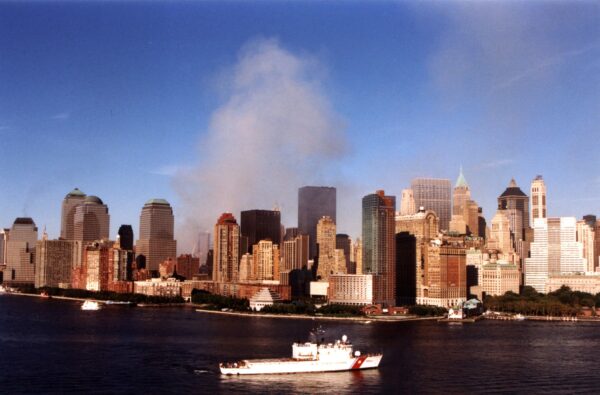
The Coast Guard’s response in New York on 9/11 is understandably remembered for the extraordinary maritime evacuation of lower Manhattan. Hundreds of commercial vessels, ferries, tugs, pilots, Coast Guard units, and other responders participated. Coast Guard personnel helped coordinate the movement of hundreds of thousands of people from Manhattan while simultaneously moving responders and supplies toward Ground Zero. It remains one of the most extraordinary examples of government-industry cooperation in American maritime history.
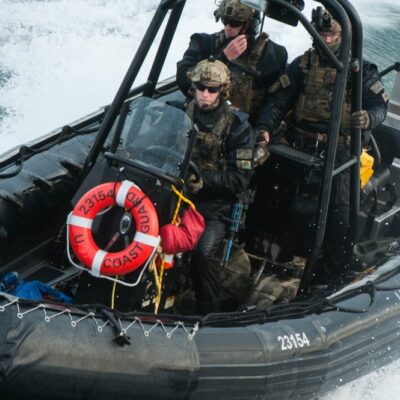
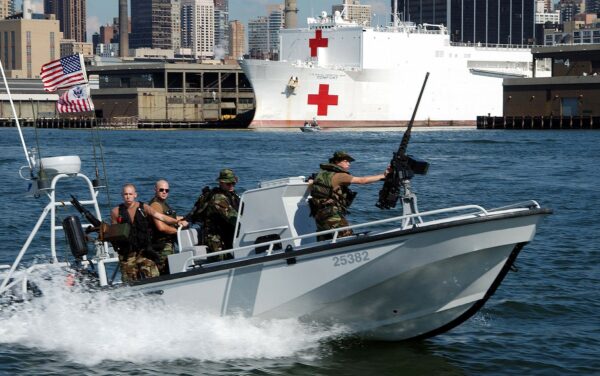
For Coast Guard Activities New York, the evacuation was only the beginning. The attacks of 9/11 triggered the largest port security operation since World War II involving 1,600 Coast Guard members from 143 units and 60 cutters, boats and aircraft operating around the clock. The intense operational tempo continued for months, and the scale of the effort was extraordinary, driven in part by a surge of intelligence warning that additional attacks—including attacks targeting the Coast Guard and other response agencies—could be imminent. For perspective, across several key measures – including high-interest-vessel boardings, small-boat operating hours, security escorts, facility inspections, and container inspections amongst others – the pace of operations generated by Activities New York during the six months after 9/11 was on par with that of the entire Coast Guard nationwide over a comparable six-month period today.
At higher levels, Coast Guard leaders were confronting fundamental institutional questions: What resources did the service need? What authorities needed to change? What policies and doctrine were required? But the field could not wait for all those questions to be answered; people on the front lines had to operate immediately in an environment for which much of the guidance had yet to be written.
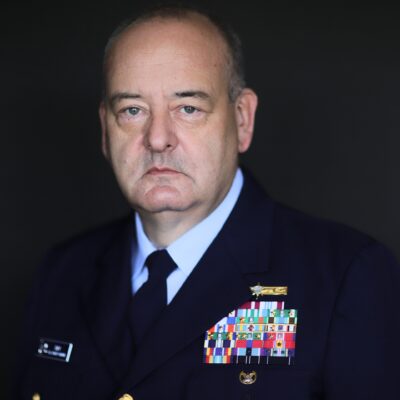
A critical leadership lesson from 9/11 was that an organization’s ability to succeed in a crisis is largely determined before the crisis begins. Leaders build that capacity by focusing on the fundamentals of good leadership – developing subordinate leaders, establishing trust, encouraging collaboration, communicating effectively, and creating an environment in which people are expected to adapt and innovate. Rear Adm. Richard Bennis built such an organization at Coast Guard Activities New York. When 9/11 hit, the crisis did not create his leadership culture – it revealed its value.
Bennis did not foresee 9/11. No one there could have designed a plan specifically for what occurred that morning, but leaders can create an organization prepared for the unexpected. Activities New York already possessed several important advantages. The command itself represented an unusual organizational experiment, integrating previously separate operational and marine-safety commands and missions under a single leadership structure. Its people had extensive experience planning and responding to major events, including OpSail 2000, and the command had embraced the Incident Command System (ICS) to coordinate the efforts of maritime response partners well before it became standard Coast Guard doctrine.
But to Bennis, preparedness was broader than having plans. Plans can become obsolete the moment circumstances change. What mattered more was building an organization accustomed to working collaboratively, making decisions and adapting to changing circumstances. You don’t prepare an organization only for the crises you can imagine; you build one capable of dealing with those you cannot.
But organizational preparedness alone was not enough. Bennis knew that trust can be leveraged during a crisis, but it cannot easily be created during one. External relationships built through routine operations, exercises, planned events, and collaborative maritime governance become genuine operational capabilities during crises. He empowered his senior leaders to build and nurture those relationships, allowing the organization to be already leaning forward on 9/11.
The Harbor Safety Committee was one example – Activities New York had structured the committee to bring together government, law enforcement, and maritime industry leaders to anticipate emerging safety and port security needs before 9/11 made them the focus nationwide. As one example, vulnerability assessments were already underway on the port’s 150 pieces of critical infrastructure and drove the force laydown after 9/11. Critical relationships did not have to be created after the attacks; they could immediately be put to work to help refine rapidly changing Coast Guard security activities such as offshore boarding and escort procedures. The approach would later inform the Area Maritime Security Committee model adopted nationally.
Relationships provided access to capabilities, but people still had to exercise the leadership necessary to use them effectively in a dynamic environment. Bennis deliberately recruited people that would lean forward and lead. While he valued technical competence, he put a premium on leaders with judgment, initiative, confidence, and the ability to build teams, draw upon technical expertise and make decisions when circumstances were ambiguous.
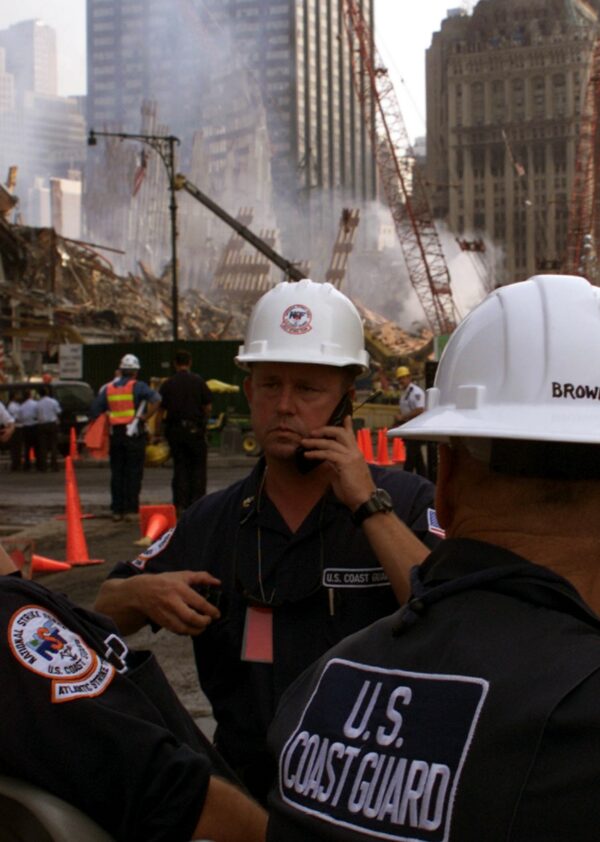
Developing capable leaders mattered only if they were actually trusted to lead. Bennis’ command subordinate leaders, particularly his cadre of division chiefs, had substantial responsibility. Bennis expected these officers to function as a leadership team. He set the conditions for them to collaborate, challenge one another, solve problems collectively, and continuously improve the command. He didn’t build followers nor did he cultivate independent stars – he built a team of leaders. Further, he knew the organizational boundaries that defined their responsibilities in normal operations could not be allowed to define their response to the crisis.
This mattered because 9/11 immediately became a genuinely multi-mission operation. Within hours, Activities New York used ICS to bring search and rescue, port security, waterways management, pollution response, marine inspections, intelligence, container operations, and facility security under an integrated framework and to coordinate the effort of 35 federal, state and local agencies involved in the response.
Early in the 9/11 response, Bennis’ direction to his division chiefs was remarkably simple: “Go be brilliant.” Taken out of context, that might sound insufficient for an unprecedented national crisis. It was not. His team understood what he meant because of everything that had happened beforehand. Those words communicated: I trust you and your judgment; you understand the mission; you know your people; you know my expectations; you have the authority to act. His commander’s intent provided something more durable and responsive to a rapidly changing environment than detailed instructions: an understanding of what must be accomplished and why, allowing subordinate leaders the freedom of maneuver to determine how.
This level of trust was not abdication. Bennis and the deputy commander, Capt. Patrick Harris, remained informed, provided appropriate oversight and ensured that efforts remained aligned with their intent. But they did not feel compelled to provide constant direction merely to demonstrate that they were in command. This rare level of empowerment allowed them to focus on other key leadership tasks such as being visible to the people running the operation, creating confidence, reassurance, a sense of stability and control, which were contagious and crucial in an uncertain environment. Bennis similarly provided public reassurance that the Coast Guard was protecting the people of the region and the nation, and that commerce could move through our ports even under the “new normal.” He also provided the support and encouragement his people needed to perform at their best, making every officer, enlisted member and civilian member of the unit and the task force feel valued.
 On 9/11 and in the many other crises that he and his team faced in New York, Bennis deliberately focused up and out, managing the “event,” while his subordinate operations and logistics leaders focused down and in, managing the “incident.” He interacted with senior Coast Guard leadership, engaged political and governmental leaders, obtained resources and maintained a holistic view of operations and supporting logistics. His trusted subordinate leaders ran the incident, managed forces, established operational priorities, adapted tactics and solved problems. This is unwritten Coast Guard doctrine today, but under such extraordinary conditions as 9/11 it was particularly effective. Further, when it came time to tell the Coast Guard story to the public, he empowered those that led operations to be the face of the Service, providing extraordinary opportunities for exposure through multiple national or international engagements every day.
Trust in subordinates became particularly important when leaders encountered problems for which neither Bennis nor Coast Guard headquarters could provide ready answers. Following 9/11, national policies, doctrine, resources, authorities, and organizational constructs were evolving while field commands were already executing the mission. The objective in New York was not to innovate for innovation’s sake; it was simply to accomplish the mission. But necessity drove experimentation, and the solutions developed in the field contributed to broader changes in the Coast Guard.

Bennis’ expectation before 9/11 was that his leadership team would continuously improve, adapt, and solve problems in real-time. 9/11 dramatically accelerated that process. Innovation became part of operations.
Some innovations were tactical. Marine inspectors and operational personnel formed integrated boarding teams. They developed procedures for identifying, intercepting, boarding, and escorting high-interest vessels before they entered the port. Pilot boats provided platforms for boarding teams, Sea Marshals extended Coast Guard control aboard selected vessels, and use-of-force procedures evolved to address the realities of conducting security operations in one of the world’s busiest ports.
Other innovations addressed command and control and the use of major cutters in the port environment. The command expanded intelligence capabilities and created new information-sharing arrangements, while new technologies helped provide commanders and deployed forces with blue force tracking and a common picture of activity across the port.
Innovation was not the objective; accomplishing the mission was. When existing approaches fell short, people were expected to find an answer. The result was an extraordinary period of field-driven experimentation and bottom-up problem solving in which operational necessity produced solutions that were tested, modified, sometimes discarded, and, when successful, often adopted more broadly.
Some of these experiments led to broader institutional change. The integrated Activities organization provided a model for the later Coast Guard Sector construct; the employment of mobile forces such as Port Security Units and Tactical Law Enforcement
Teams for domestic port security helped inform the development of Maritime Safety and Security Teams; and new approaches to field intelligence helped shape capabilities that would later be formalized across the Coast Guard.
That need for adaptation did not end when the immediate crisis passed. Nearly a year later, Activities New York was still encountering situations for which existing doctrine provided incomplete answers. On the first anniversary of 9/11, Coast Guard inspectors aboard Motor Vessel Palermo Senator detected radiation while the ship was already at berth. With doctrine for such an event still immature, the ship was ordered back to anchorage under security while Activities New York assembled a response with the FBI, Department of Energy’s Nuclear Emergency Search Team, and Navy SEALs. The radiation was ultimately traced to naturally radioactive clay pots. The episode illustrated a continuing reality: even as national capabilities and doctrine matured, field commanders would still encounter situations no plan had fully anticipated.

Bennis created an environment in which change did not depend solely on direction from above. He expected leaders closest to the problem to adapt to accomplish the mission, learn from experience, and push effective solutions upward. Direction flowed down through commander’s intent; ideas and innovation flowed up from the people actually confronting the problem. Innovation began with a command climate in which people had both permission—and an expectation—to solve problems.
Twenty-five years later, Bennis’ three words remain memorable:
“Go be brilliant.”
But the lesson wasn’t the phrase itself. The real lesson was everything that made those words possible. Bennis ensured Activities New York was prepared, had built pre-need relationships, had developed and empowered teams of leaders, and created an environment of innovation and adaptation.
The ultimate measure of senior leadership isn’t simply how well the leader personally performs during the crisis. It is how well the organization performs when its people encounter problems the leader never anticipated and cannot personally solve. When the unimaginable occurred on 9/11, he did not suddenly need to invent a new leadership philosophy. The crisis revealed the value of the one he had already established.
“Go be brilliant” was simply Bennis’ way of telling his people that he trusted them to do their jobs. His team came to understand that those three words represented something much larger. They reflected years of deliberate, fundamental leadership applied and amplified in unprecedented circumstances. Creation of those conditions, more than any individual decisions made during those extraordinary months, remains one of the most enduring leadership lessons from 9/11 and Activities New York.
National Coast Guard Museum insider tip: The Coast Guard’s immediate response to 9/11 will be explored in Deck 2’s Lifesavers Around the Globe wing, highlighting the heroic work CG crews did to assist in the evacuation of Lower Manhattan. Additionally, the impact of 9/11 on everything from national security to environmental response will be explored throughout all other museum wings.