Drawing Under Fire

Combat artist Norman Thomas and the Coast Guard in World War II

Born in Massachusetts in 1915, Norman Millet Thomas loved to paint. In his high school yearbook, he noted his desire to attend the Yale School of Art. Instead, after graduation from Portland High School, in Maine, he attended the Portland School of Fine Art, and The National Academy of Design in New York City. In 1938 he was awarded a Pulitzer traveling scholarship for painting a mural of a lobsterman and spent the following year at the American Academy of Art in Rome.

In April 1942, at age 26, Thomas visited a Coast Guard recruiter. After the recruiter informed Headquarters of Thomas’s interest in the service, a memorandum from the Commandant made its way to the Officer-in-Charge of Recruiting Substation Boston:

In the event subject man presents himself for enlistment, and is found physically and otherwise qualified therefore, he may, in view of his background and qualifications as an artist be enlisted in the rating of Seaman 1st Class…. Inform Headquarters by letter when this enlistment is consummated.
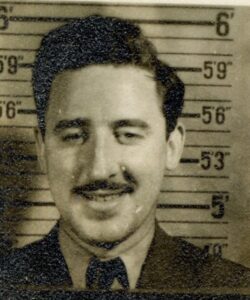
Photo: Norman Millet Thomas
Enlistment photograph of Combat Artist Norman Millet Thomas.

The Coast Guard wanted artists, such as Thomas. He was subsequently enlisted, declaring his profession as a “freelance artist.” After completing boot camp, he was sent to New York, then Boston where he was assigned to the cutter Northland for duty in Greenland.

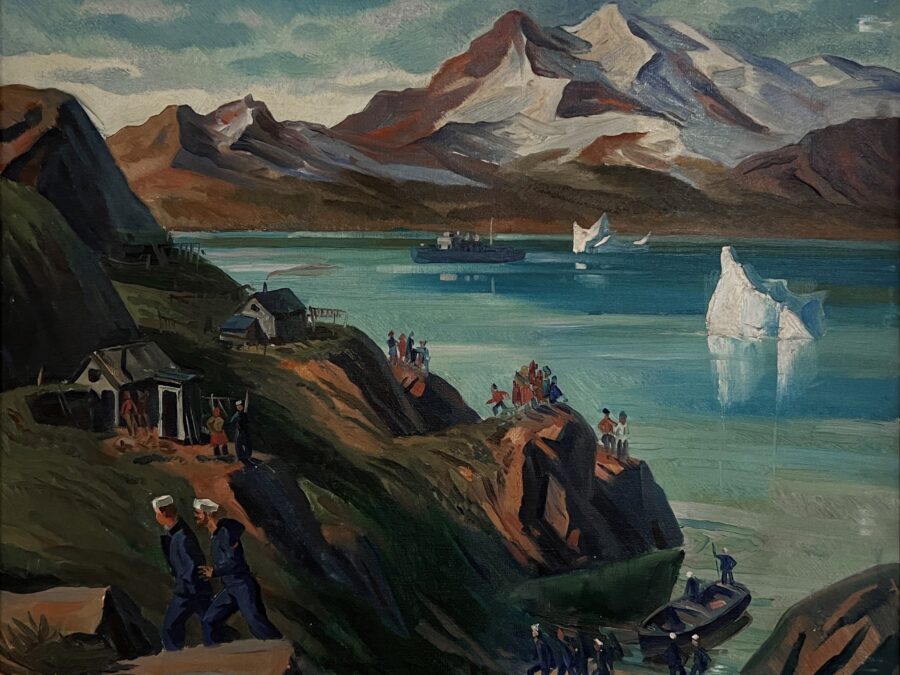
Coast Guard involvement in the war had already begun before the Japanese attack on Pearl Harbor. To the far northeast, the Island of Greenland had become strategically important. It could provide a refueling point for aircraft bound for England and support weather stations for convoys transiting the North Atlantic. President Roosevelt expected the Germans to establish weather stations in Greenland, possibly even try to take the island. In April 1941, Greenland was placed under the protective custody of the U.S. Coast Guard ships, assigned to the newly established North East Greenland Patrol, were ordered to patrol along the island’s east coast. Originally, that patrol consisted of Coast Guard-manned vessels Northland, North Star, and Navy-manned USS Bear.
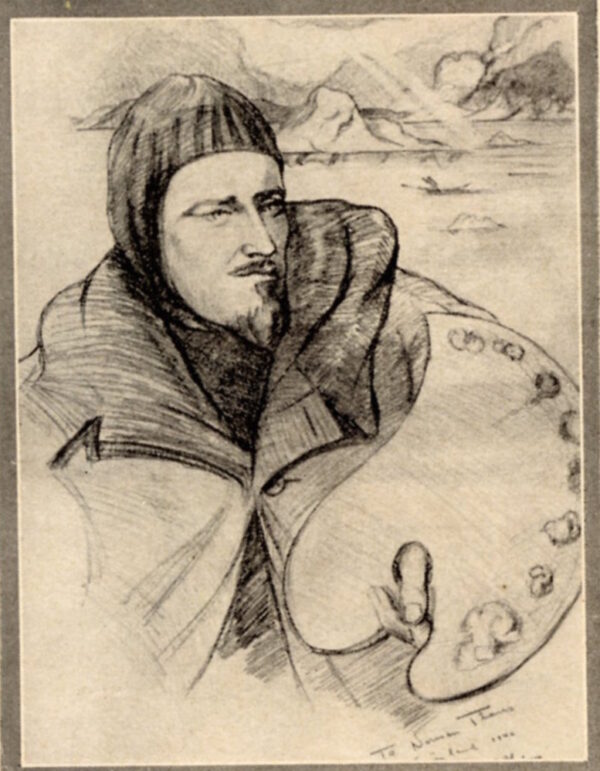
Drawing: Portrait of Norman Thomas

Credit: U.S. Coast Guard

Combat artist Benjamin Wolf sketched this portrait of Norman Thomas.

In October 1941, the Greenland Patrol was formed under the command of legendary Cmdr.  Edward H. “Iceberg” Smith. When Germany declared war on the U.S., some two months later, additional vessels were needed for escort and patrol duties. Where did they find them? Iceberg Smith learned about a fleet of ten fishing trawlers in Boston. He cabled Vice Adm. Russell Waesche who commandeered the vessels and manned them with hand-picked crews. One veteran described the 120-foot vessels as resembling huge wooden shoes.

One of these vessels was Natsek, with a crew of 23 men and commanded by Lt. J.g. Thomas LaFarge. Prior to joining the Coast Guard, LaFarge was a Works Progress Administration (WPA) painter, creating the murals that grace the U.S. Post Office in New London, Connecticut.
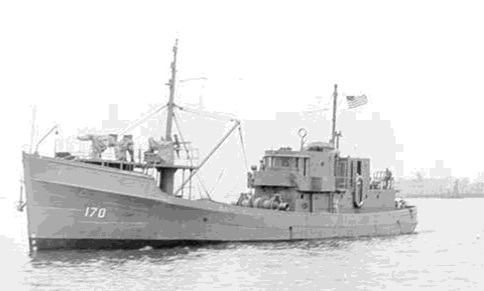
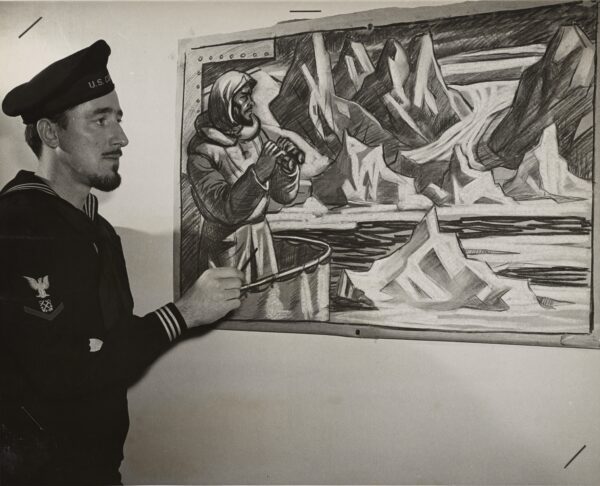
Photo: Port view of Trawler Natsek.

Credit: U.S. Coast Guard

Coast Guard trawler Natsek, of the Greenland Patrol photographed in Boston Harbor, 1942.

Drawing: This image depicts Coast Guard Combat Artist Norman Millet Thomas, who served in Greenland and the Pacific, with one of his paintings.

Credit: National Archives

“Coast Guard Coxswain Turns to Former Profession as Hobby While Icebound in Arctic” -- Coast Guardsman Norman Thomas, 27, of 571 Cumberland Avenue, Portland, Maine, a Coxswain in the Coast Guard, whiled away his time while his ship was icebound in the Arctic for a month by painting scenes of the activities. The paintings were lost, however, when they were shipped back to Headquarters on the Natsek, which ship was announced missing at sea a few weeks ago. Thomas, an artist by profession and winner of the Pulitzer Art Prize in 1939, now is doing another set from memory on assignment from Washington for a war record on canvas of Coast Guard activities. He is shown with one of these paintings.

In June 1942, Iceberg Smith requested “in furtherance of a program of public relations and an art record of the war operations of the Coast Guard’ that three artists be assigned to temporary duty with the Greenland Patrol.” Seamen First Class Norman Thomas and Seaman First Class Benjamin Wolf were two of those artists. They produced artwork outside of “normal” duties, including standing watches, with Thomas on the Northland and Wolf aboard North Star. Not surprisingly, they befriended Natsek’s commanding officer. By October 1942, the two artists had completed about 40 pieces of work. Iceberg Smith ordered those pieces inventoried and packed for shipment back to the States.

On Dec. 14, 1942, Natsek departed Narsarssuak with the minesweeper USS Bluebird and Natsek’s sister ship, Nanok, bound for Boston. Bluebird was delayed, and with Natsek and Nanok making greater speed than could Bluebird, the ships parted company. Boatswain’s Mate Second Class Thaddeus Nowakowski, serving aboard Nanok, kept a diary.
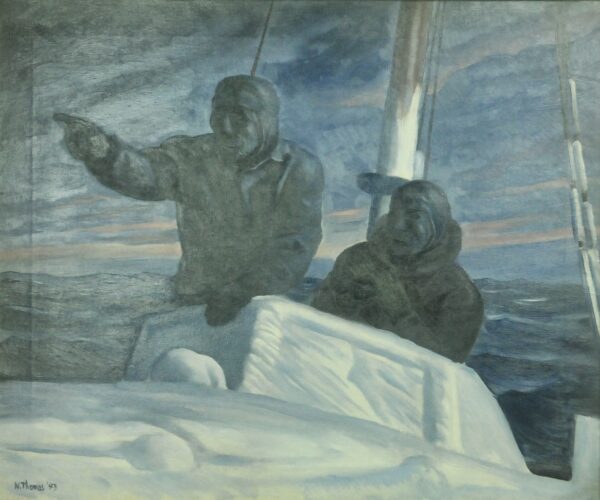
Painting: Blue tinted image where lookout points something out in the distance.

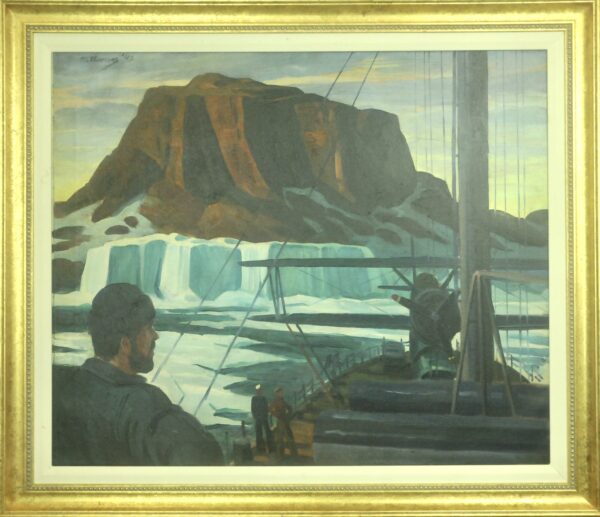
Thomas’s “Icy Lookout” was recreated by Thomas and featured in Life Magazine. It depicts Coast Guardsmen standing watch in the frigid cold of Greenland.

On December 14, he wrote,

Almost at the moment we enter open sea, a great ground swell develops and wind makes its hiding place known. It bites the cheeks, gently at the beginning, then intensifying like an arousing lover. Near day’s end, swells become monumental. Waves and wind become unbridled fury.

The following day, he recorded,

Sea and wind are very high and rough. Snow falls intermittently. Looking in any direction, the view is similar, either boiling mountains of water or white walls of falling snow. I am not knowledgeable about the dangers of heavy icing conditions…There is definitely an unspoken fear in the eyes of much of the crew. On board the Nanok, ice chopping is continuous around the clock. On board the Natsek on our port beam, there is no visible ice chopping.

No relief was in sight on December 16:

The deck is a wonderland of wet, packed snow, and ice. The Nanok carries almost twice the ice she carried yesterday. It clings mostly to her forward half and to its entire starboard side. The Natsek is riding heavily and deep in the sea. She is still abeam of our portside, beyond shouting distance. If anyone on board her is chopping ice, they are not visible.

Belle Isle Strait Lighthouse was sighted at approximately 1 a.m. on December 17.

Later we close-haul the Natsek so Maggie (Nanok’s commanding officer) and La Farge can shout back and forth to one another. Not being on the scene at the time, I do not learn the true state of Natsek’s icing condition. Others, however, say Natsek is an iceberg. Maggie decided both vessels would proceed together in the semi-darkness even though visibility was barely marginal. Nature had other plans. Snow soon thickens and the Natsek blends into it. To verify Natsek’s proximity, Maggie heaves-to and sounds two long blasts of Nanok’s horn. The only reply is a single flash of white light.

With her fathometer inoperative, Nanok proceeded slowly, cautiously, and alone.

The weather deteriorated rapidly. Winds reached gale force and the spray formed more ice on Nanok’s superstructure. The crew battled to break off the ice. Said Nowakowski, “We are in a witch’s cauldron. Mountainous waves, howling wind, and skin searing airborne wave tops. Either the waves are growing ever higher and more vicious, or my mind is on its way elsewhere!”

Nanok survived. Natsek was never seen again. She was declared officially lost with all hands on March 25, 1944. Stored within Natsek’s hold were more than 40 pieces of art created by Norman Thomas and Ben Wolf. A number of these works were recreated and featured in Life magazine.  A second deployment to Greenland resulted in more work by Thomas.
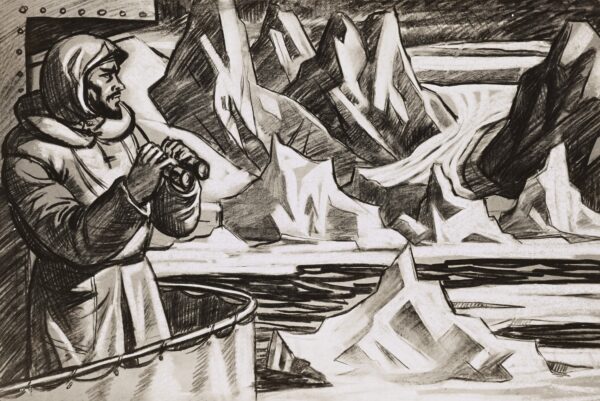
The Greenland Expedition

  • “Coast Guardsman in Greenland” – Coast Guardsman sits watch aboard a vessel in Greenland.

    Drawing: This image depicts a Coast Guardsman on watch aboard a vessel in Greenland.

    National Archives

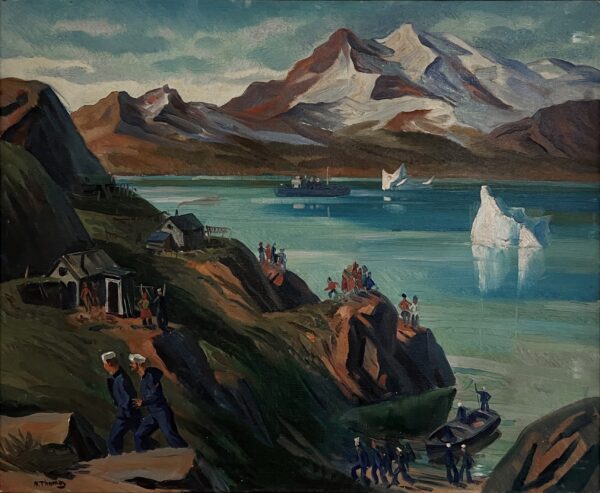
  • Another Thomas painting from Greenland showing a view off the stern of the Northland showing her J2F Grumman “Duck” amphibian aircraft.

    Painting: A view off the stern of the Northland showing her J2F Grumman “Duck” amphibian aircraft with iceberg and mountain in the background.

    U.S. Coast Guard

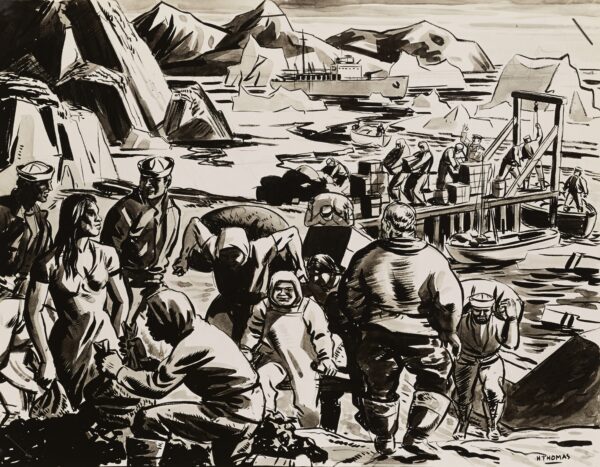
  • "Soldiers and Coast Guardsmen Go Ashore" -- Coast Guardsmen and soldiers go ashore from the Coast Guard cutter, moored to solid, shore-fast ice. Guns of the Coast Guard cutter cover the Americans as they launch their attack. This sketch was made by Norman Thomas, Coast Guard combat artist in Greenland.

    Drawing: This image depicts Soldiers and Coast Guardsmen setting out to attack German positions in Greenland.

    National Archives

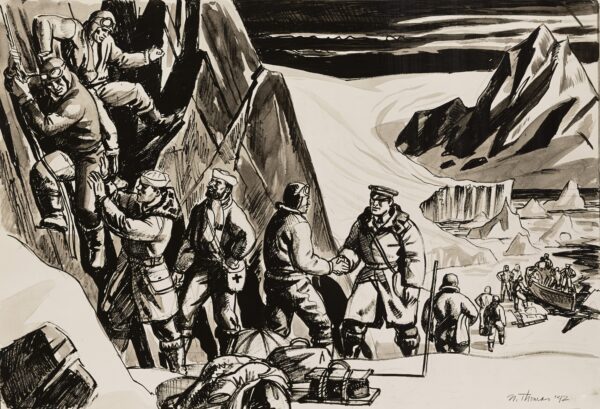
  • “Coast Guardsmen Rescue Canadian Fliers” -- The dramatic rescue by Coast Guardsmen of three stranded Canadian fliers from Greenland's frigid ice cap is depicted in this painting by Coast Guard Combat Artist Normal Thomas. While flares and star shells were fired from a Coast Guard cutter to guide the lost fliers toward its anchorage, Coast Guard Lieutenant John A. Pritchard, Jr. led a rescue party over treacherous glacier ice on skis and snowshoes, finally reaching and exhausted Canadians and carrying them back to the cutter and safety. Lt. Pritchard was lost two months later in another rescue mission, when the plane he was flying crashed in the frozen wastes.

    Drawing: This image depicts Coast Guard Lieutenant John A. Pritchard, Jr. rescuing Canadian pilots stranded in Greenland.

    National Archives

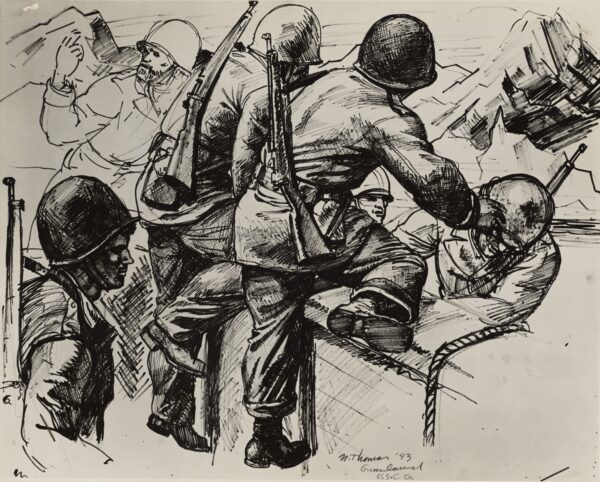
  • “Commandos in Greenland” -- Coast Guard Commandos of Greenland Patrol go over the side of the U.S. Coast Guard Cutter to attack German forces in Greenland. Coast Guardsmen in foreground wear regulation Arctic clothing except for steel helmets. Sailors in foreground receive special training in Arctic Landing operations prior to start of expedition. This was the first United States Expeditionary Force ever to land and conduct operations under cover of darkness were impossible because of perpetual daylight at this season of the year. Temperatures were generally below freezing except in the late forenoon and early afternoon. Coast Guardsmen landed with and supported United States troops. (This sketch was made by Coast Guard Combat Artist Norman Thomas in Greenland.)

    Drawing: This image depicts Coast Guard commandos preparing to attack German soldiers in Greenland.

    National Archives

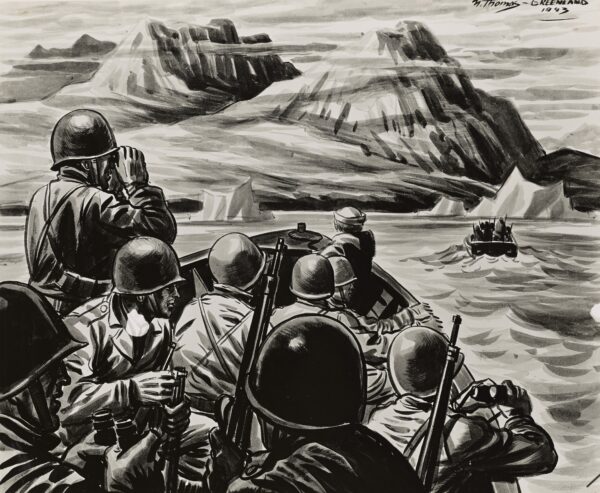
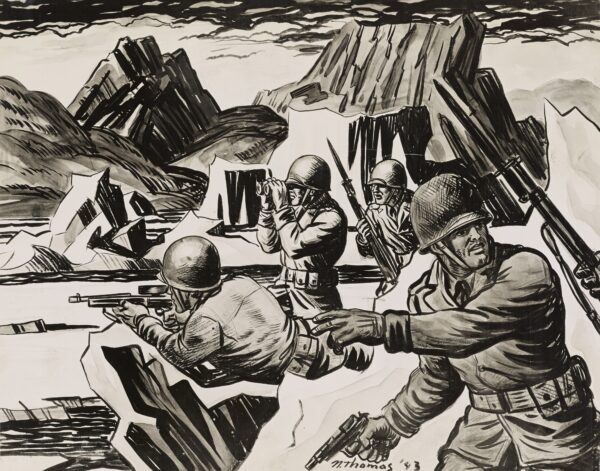
  • “Commandos in Greenland” -- United States Army and Coast Guard commandos of the Greenland Patrol advance toward shore past field of pack ice and bergs to investigate area reported by United States Coast Guard cutter's reconnaissance plane as suspicious. Approach to shore other than across floes of store ice (polar pack ice) was impossible. Crossing ice is dangerous work as sudden wind will cause pack to shift. (Sketched by Coast Guard combat artist Norman Thomas in Greenland.)

    Drawing: This image depicts Army and Coast Guard commandos patrolling suspicious activity in Greenland.

    National Archives

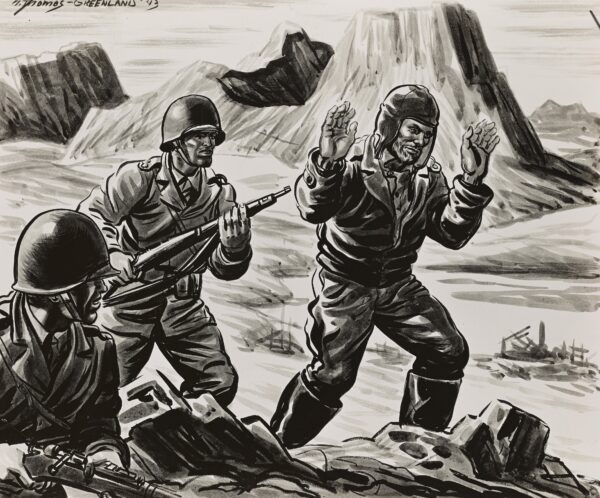
  • "Commandos in Greenland Capture German Officer" -- Hungry and cold, this prisoner, a junior officer in the German Navy, Doctor Rolf Sensse, was discover in mopping up operations. He expressed surprise at the humane treatment afforded him by his U.S. Army and Coast Guard captors. He was one of a German force that traveled up and down the coast of Greenland, destroying Danish settlements and radio stations. (This was sketched by Coast Guard Combat Artist Norman Thomas in Greenland.)

    Drawing: This image depicts Army and Coast Guard Commandos as they capture Dr. Rolf Sensse of the German Navy in Greenland.

    National Archives

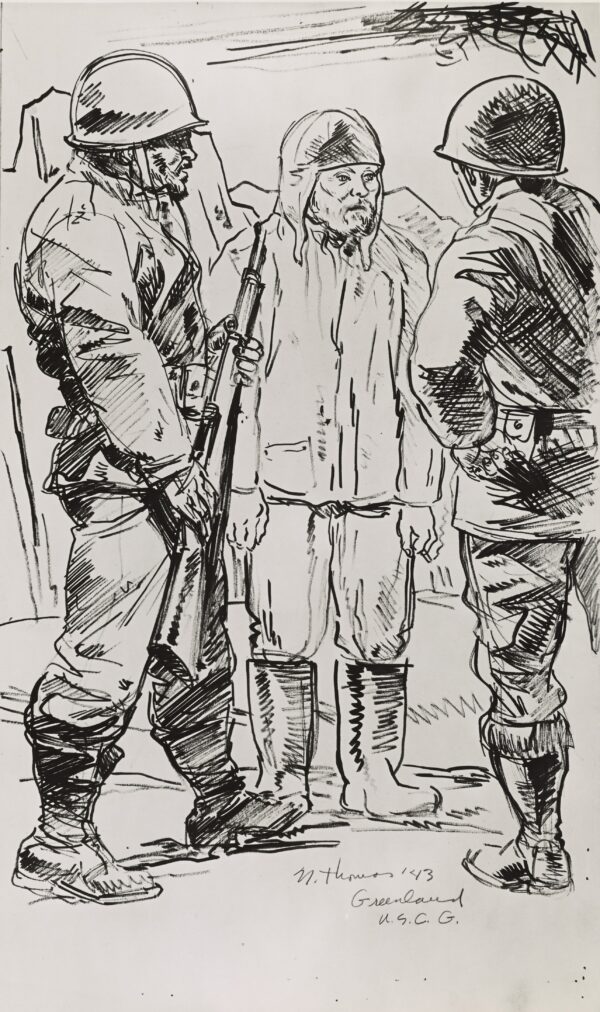
  • “Commandos in Greenland Capture German Officer” -- Sketch made on the spot of a German prisoner, a Junior officer of hte German Naval forces who occupied a radio station in Greenland, being questioned by a U.S. Coast Guard officer. This prisoner was taken in mopping up operations immediately following the occupation by the U.S. Coast Guard. The prisoner had been hiding from the U.S. forces in the rocky terrain of the island and had been without food or shelter for a number of days, all German stores having been seized by the Coast Guard. He is pictured smoking a cigarette given by a U.S. soldier and expressed surprise at the humane treatment given him by the Americans. Although a convinced Nazi, the prisoner expressed great fears as to the outcome of the war in respect to Germany and it was obvious that recent Allied successes had him greatly worried. That he and the German forces with him had been routed out of the almost impregnable wilderness of Greenland was symptomatic of the Allied determination to seek out and destroy Nazi Menace wherever found. (Sketched in Greenland by Coast Guard combat artist Norman Thomas.)

    Drawing: This image depicts Army and Coast Guard Commandos as they capture a junior officer of the German Navy in Greenland.

    National Archives

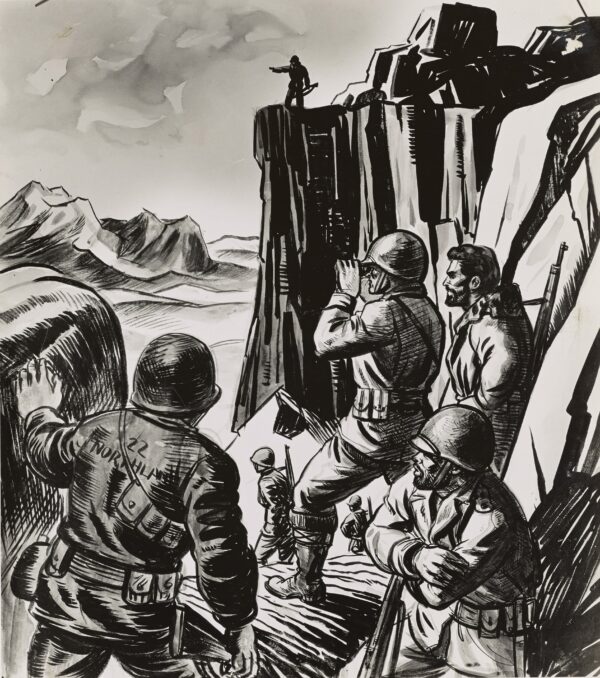
  • “Commandos in Greenland” -- Mixed landing forces of United States Coast Guard and Army Commandos, members of the Navy's Greenland Patrol Expeditionary Force, search the rugged terrain of Greenland for remnants of destroyed German military force. German Naval and military forces were operating a radio and weather station in Greenland which because of its location, made meteorological observations of important value to enemy operation int he Norwegian Theatre. Despite low temperatures, mountain climbing in heavy clothing is tough and makes landing forces perspire. One sailor removed his helmet to cool off. Sketched in Greenland by Coast Guard combat artist Norman Thomas.

    Drawing: This image depicts Army and Coast Guard commandos patrolling for remnants of German activity in Greenland.

    National Archives

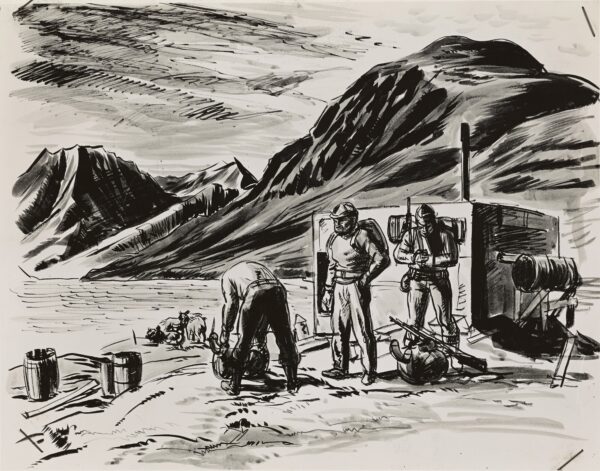
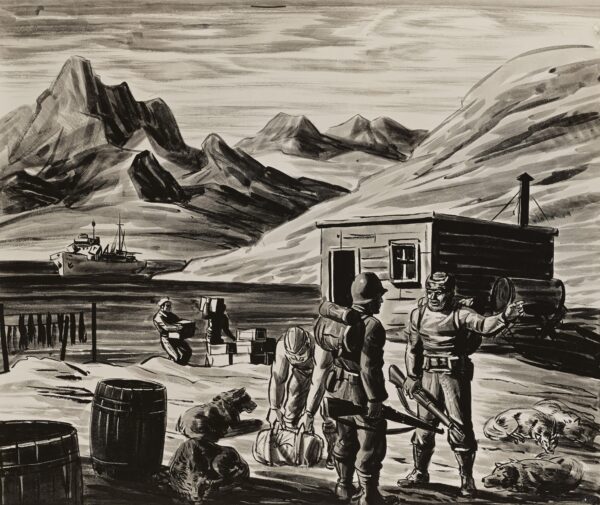
  • “Preparing for Reconnaissance Patrol” -- Two U.S. Army Scouts and a corporal of the Greenland Army are sketched by Coast Guard Combat Artist Norman Thomas as they prepare to go inland on a reconnaissance patrol. According to the Coast Guard artist, this typical of Greenland terrain.

    Drawing: This image depicts American and Greenlandic Army personnel prepare for a patrol in Greenland.

    National Archives

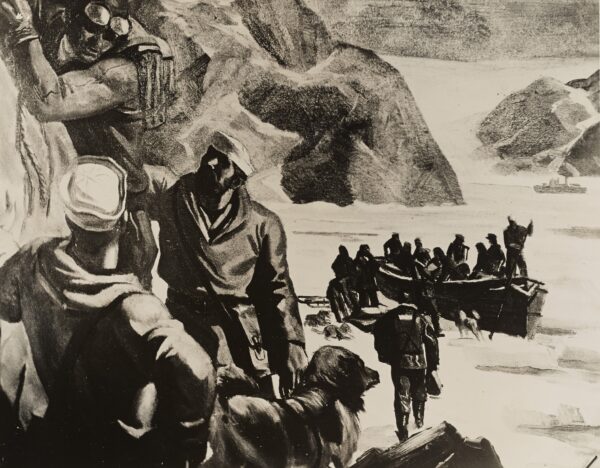
  • "Scouts Set Out for the Hills" -- U.S. Coast Guardsmen unload supplies from their ship as two U.S. Army scouts with a corporal from the Greenland army as guide leave to scout the hills for the Germans suspected of being there. Sketched in Greenland by Coast Guard combat artist Norman Thomas.

    Drawing: This image depicts Coast Guardsmen unloading supplies as American and Greenlandic personnel prepare to set out on patrol.

    National Archives

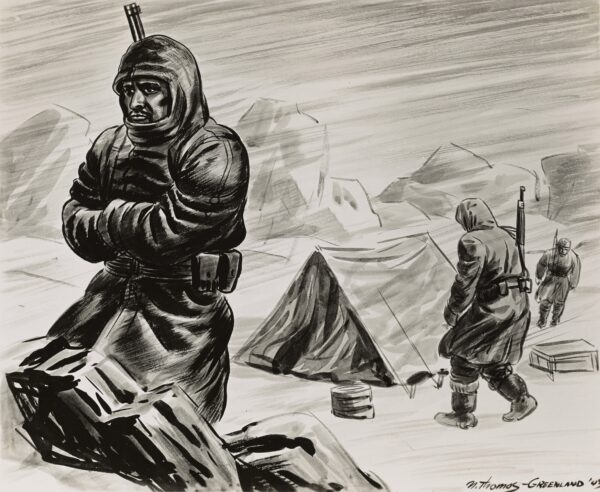
  • “Reconnaissance Patrol” -- Reconnaissance patrol left to occupy Coast Guard base in Greenland makes camp. Patrol must spot approach of any hostile ships or planes and inform a Coast Guard cutter. This sketch was made by Coast Guard Combat Artist Norman Thomas in Greenland.

    Drawing: This image depicts Coast Guardsman on patrol in Greenland.

    National Archives

  • “U.S. Coast Guard Rescues Canadian Fliers” -- Deep in the frozen north three Royal Air Force airmen are rescued from the bleak Greenland ice cap by the U.S. Coast Guard. Lt. John A. Pritchard, Jr., 29 year old Coast Guard aviator of Burbank, California, who later met death during another rescue attempt, led a party of Coast Guardsmen ashore while those on board the cutter, commanded by Commander Francis C. Pollard, fire flares and star shells to guide the stranded airmen to the ship. Traversing treacherous glacier ice on skis and snow shoes, Pritchard and his men reach the exhausted fliers and carried them to the cutter, Norman Thomas, of New York, Coast Guard combat artist, who was in Greenland then, sketched the rescue scene.

    Drawing: This image depicts Coast Guard Lieutenant John A. Pritchard Jr. rescuing Canadian pilots stranded in Greenland.

    National Archives

  • “Personnel in Greenland”

    Drawing: This image depicts American and Greenlandic personnel in Greenland.

    National Archives

Upon his return to the States, Thomas was ordered to the Fourteenth Naval District, Territory of Hawaii, for assignment to duty. On Oct. 17, 1944, he boarded USS Callaway bound for the Pacific. This Coast Guard-manned Bayfield-class attack transport had landed troops at Kwajalein, Emirau, Saipan, Angaur Island, and Leyte Gulf. Preparations in New Guinea preceded Callaway’s participation in the assault on Lingayen Gulf, a large inlet on the South China Sea, that cuts into the western coast of Luzon. It was here that the transport would distinguish itself as part of Blue Beach Attack Group. On Jan 3, 1945, Thomas’s temporary posting to Callaway was made permanent.
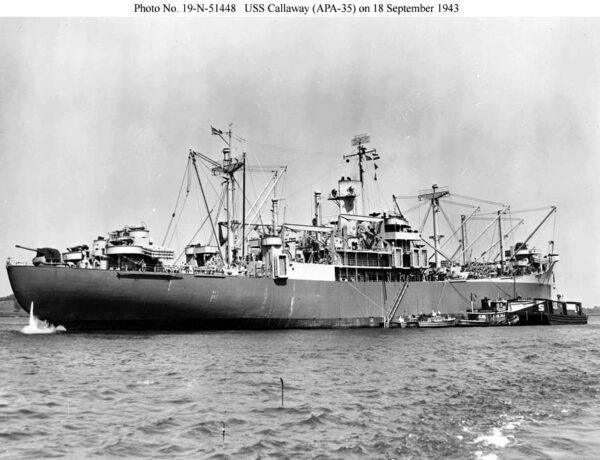
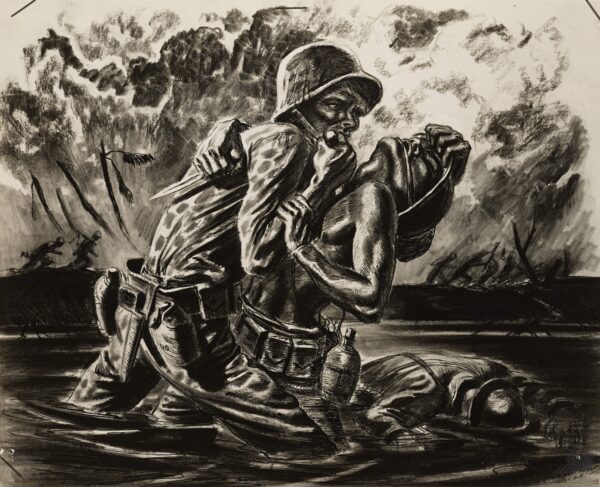
Photo: Starboard-aft view of USS Callaway.

Credit: U.S. Coast Guard

Thomas’s ship during his assignment to the Pacific theater, USS Callaway, a Coast Guard-manned attack transport.

Luzon - The Philippines

  • "Bare Steel" -- A hand-to-hand struggle in the rice fields edging the Lingayen Gulf beaches of Luzon is dramatically portrayed in this drawing by Coast Guard combat artist Norman Millett Thomas, Chief Specialist, of Portland ME., whose art on the Luzon invasion came back soon after the establishment of the beachhead. Here, an American soldier and a Jap, thigh-deep in the water, fight to the death with their knives as invasion troops advance to mop up the enemy. Thomas, who participated in the Luzon invasion aboard a Coast Guard-manned invasion transport, previously served on a combat cutter in Greenland waters. Thomas studied in the National Academy of Design, New York City, before the war and was awarded the President's Medal and a Pulitzer Travelling Scholarship. He also studied at the American Academy in Rome, Italy.

    Drawing: This image depicts a hand-to-hand struggle in a rice field on Luzon.

    National Archives

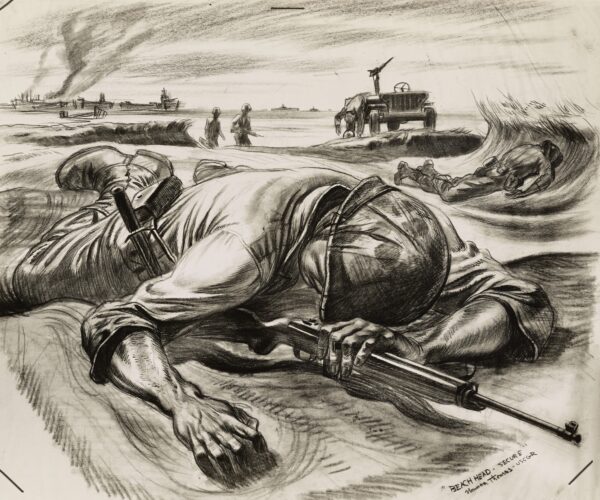
  • “Beachhead Secure – Luzon” -- An American soldier's assignment is carried out. The Luzon beachhead is secure. The G.I. is stretched dead on the Philippine sands with his rifle still clutched in his hand. Behind him ships and men continue to solidify the landing as advance troop units move forward toward Manila in this grim drawing of beachhead battle by Coast Guard combat artist Norman Millett Thomas, chief specialist, of Portland, Maine, who participated in the Luzon assault aboard a Coast Guard-manned invasion transport. Thomas is a former student of the National Academy of Design, New York City, and the American Academy at Rome. He won the President's Medial and a Pulitzer Travelling Scholarship before enlisting in the U.S. Coast Guard.

    Drawing: This image depicts a dead soldier on the beach of Luzon, having secured the beach head before his death.

    National Archives

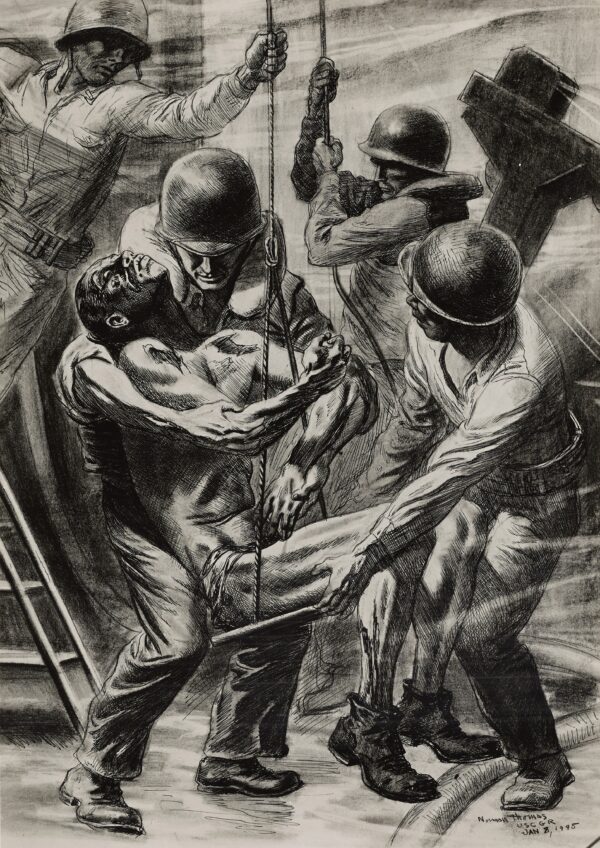
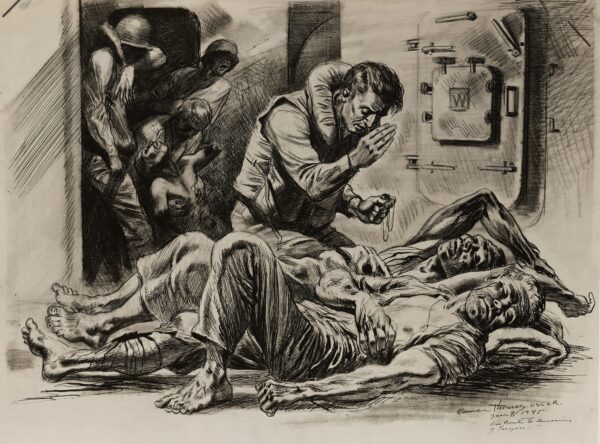
  • "I have fought a good fight.." -- You is in the agony of death. Fatally burned when a Jap bomb fell on the USS Callaway, a Coast Guard-manned invasion transport, on the way to Luzon, this Coast Guard signalman is lowered tenderly by his comrades from the searchlight platform on the ship's mast. He was at his battle station when the bomb struck the ship's superstructure. Seared by flame, another Coast Guardsman leaped from the platform into the sea. There were nearly 50 casualties aboard the Coast Guard-manned ship which had come unscathed through five earlier invasions. This wash drawing is by Coast Guard combat artist Norman M. Thomas, chief specialist, of Portland, ME., who fought the fires after the bomb exploded. The Callaway went on to Lingayen Gulf to unload troops on the first Luzon beachhead.

    Drawing: This image depicts a Coast Guardsman aboard the USS Callaway who was killed when the vessel was struck by a Japanese fire bomb during the invasion of Luzon.

    National Archives

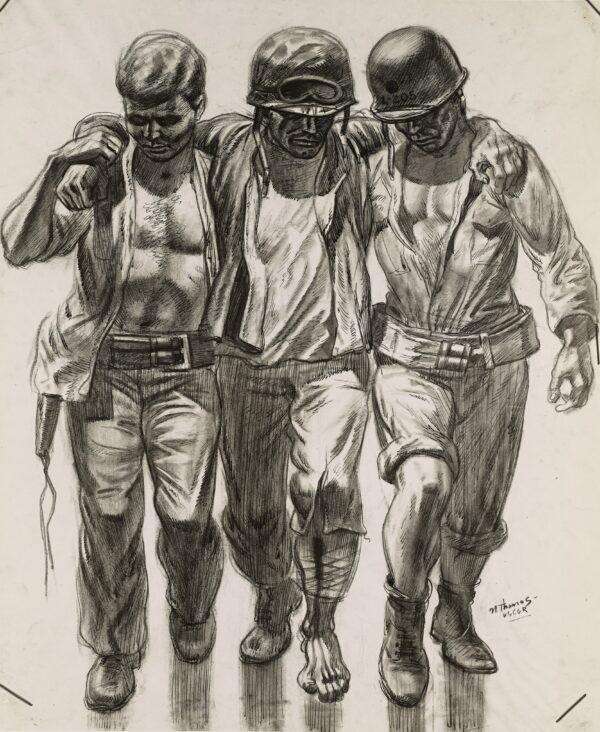
  • "The Road Back from Battle" -- Supported by two Coast Guardsmen, a wounded American soldier is moved out of the fighting on the Luzon beachhead for transport by landing bard to a Coast Guard-manned invasion transport standing off shore. This drawing of beachhead warfare is by Coast Guard Combat Artist Norman M. Thomas, chief specialist, of Portland, Maine, who served on the Greenland Patrol and now is in the Philippines. Thomas studied at the National Academy of Design, New York City, and the American Academy in Rome, Italy, before the ward. He was award the President's Medal and a Pulitzer Travelling Scholarship. In Portland, his home is at 571 Cumberland Avenue. (Sketch on which the Coast Guard World War II Memorial was based.

    Drawing: This image depicts Coast Guardsmen helping a American wounded soldier off the beach on Luzon.

    National Archives

  • “’... I have kept the faith’” -- Amidst a scene of horror on the deck of the USS Callaway, the chaplain administers the rites of his church to two dying Coast Guardsmen, after the invasion transport had taken a bomb from Jap aircraft off the coast of Luzon. Coast Guard combat artist Norman M. Thomas, chief specialist, of Portland, ME., witnessed the explosion, helped put out the fires and then made this drawing of the incident. Chief Thomas describes the scene: "... the air is filled with screams of wounded and dying men. The smell of burned flesh fills the nostrils; the eyes smart from thick smoke, the chaplain administers the rites to the dying..."

    Drawing: This image depicts a Chaplain administering last rites to two dying Coast Guardsmen aboard the USS Callaway, who were fatally wounded when their vessel was struck by a Japanese bomb.

    National Archives

Five days later, on Jan. 8, 1945, only 35 miles off the beach, Japanese aircraft came in directly behind the convoy. Callaway’s guns downed two of the three. Despite being hit, the third aircraft continued its attack with Callaway’s starboard bridge structure in its sights. With the enemy aircraft hurtling toward them, several gunners continued to fire their anti-aircraft batteries. The impact killed seven men instantly. A blaze ignited by aircraft fuel consumed dozens more. Thomas wrote, “Men were turned into human torches. Flames leaped to the top of the stack and shot down toward the engine room.” In all, 23 Coast Guardsmen were killed, another ten wounded. Thomas witnessed the crash, helped put out the fires, and sketched the carnage he had witnessed. He later wrote, “Aboard Callaway, the air is filled with screams of wounded and dying men. The smell of burned flesh fills the nostrils and the eyes smart from the smoke. The chaplain administers last rites to the dying…”
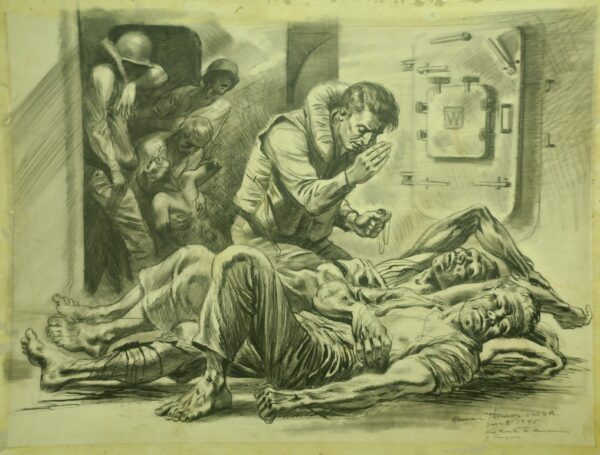
Drawing: Chaplain administers last rites.

Credit: U.S. Coast Guard

After a Japanese attack on the Callaway, Thomas sketched the carnage he witnessed. The chaplain administers last rites to the dying.

Despite the horror, the fires were contained and the damage kept to a minimum. In fact, Callaway managed to maintain her position in the convoy, a testament to her fine crew, seven of whom were awarded Silver Star Medals.

Thomas went ashore at Luzon. A Coast Guard Public Affairs release praised Thomas’s work. It stated that while sketching on Luzon’s beachhead, Thomas produced some of the best art of the war. Three weeks after that historic landing, his pictures were reproduced across the country.

Artist Thomas captured the brutality and grimness of war in his Luzon sketches as few artists have done. The high caliber of this type of art cannot be achieved by copying photographs. It must be the expression of the artist’s own conception of battle conveyed to his sketchpad from direct observation. Artist Thomas made pictures which photographs could not make…in particular his death struggle, hand to hand and knife to knife, between a Yankee and a Jap in Luzon’s rice fields.
Iwo Jima

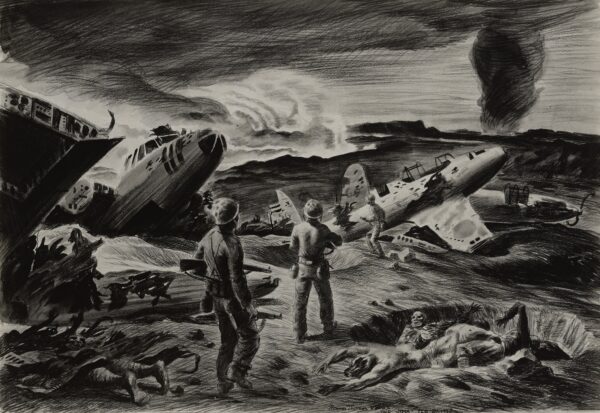
  • "Battle for Iwo's Air Strips" -- U.S. Marines advance through the wreckage of Japanese planes to relieve front line forces in the bitter battle for the air strips of Iwo Jima. Enemy phosphorus shells land just ahead as the leathernecks proceed under heavy fire from the first to the second airfield on the volcanic island south of Tokyo. This is a drawing by Coast Guard artist Norman M. Thomas, chief specialist, of Portland ME., who participated in the Iwo Jima assault from a Coast Guard-manned invasion transport.

    Drawing: plans towards the front line on the air strips of Iwo Jima.

    National Archives

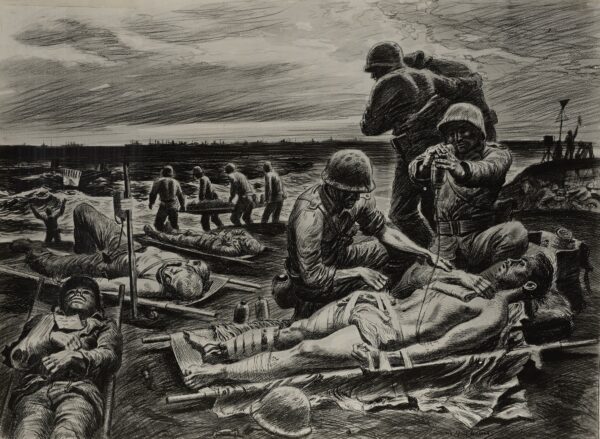
  • "Blood and Sand" -- On the black, shell-blasted beach of Iwo Jima, Marine medical corpsmen and Coast Guard pharmacist's mates give first aid to wounded comrades borne back in stretchers from the front lines. Life-preserving plasma is administered to the wounded marine in the foreground in this grim black and white drawing by Coast Guard combat artist Norman M. Thomas, chief specialist, of Portland, ME. Thomas went into the Iwo Jima holocaust from a Coast Guard-manned troop transport.

    Drawing: This image depicts Marines and Coast Guardsmen giving aid to wounded men on the beaches of Iwo Jima.

    National Archives

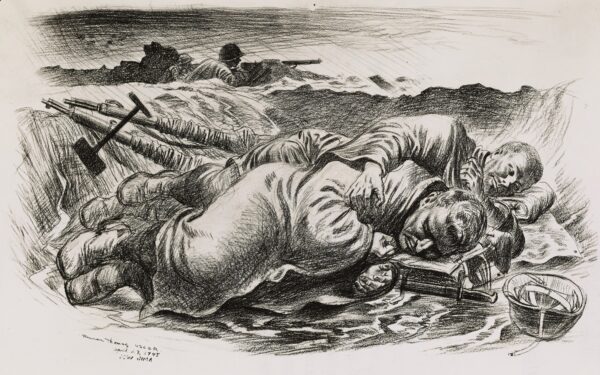
  • "Night on Iwo Jima" -- With the battle raging as furiously at night as in the day, marines catch an hour's sleep in an uncovered shellhole, while comrades man their guns in background. During the height of the fighting for Iwo, marines fought an hour and then slept an hour, always under the danger of infiltrating Japs. This sketch was made on the scene by Coast Guard combat artist Norman M. Thomas, chief specialist, who said that evacuated casualties were frequently "on the verge of collapse." Thomas is from Portland, Maine.

    Drawing: This image depicts Marines trying to sleep in a shell crater during the invasion of Iwo Jima

    National Archives

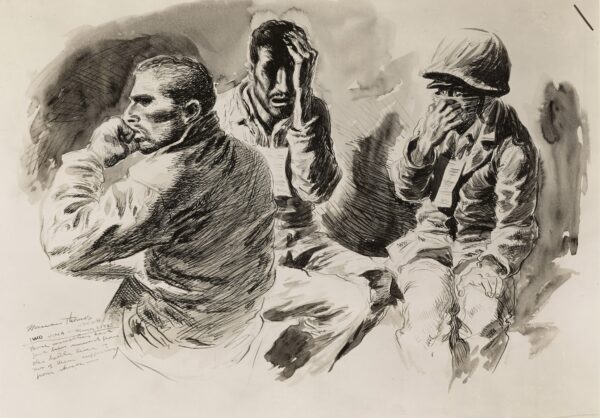
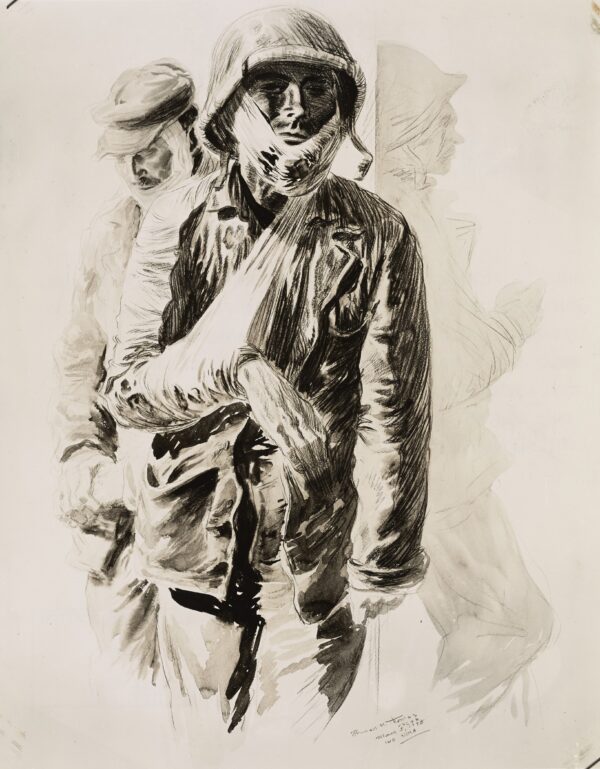
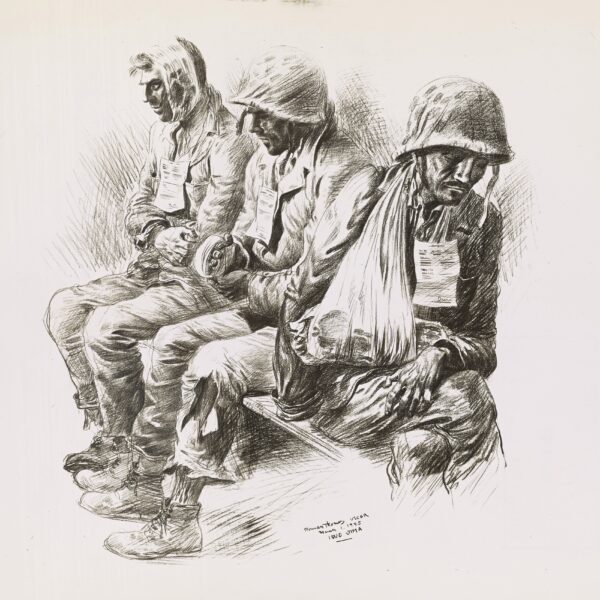
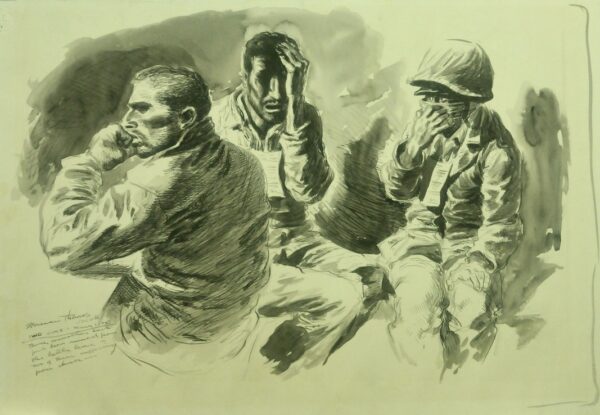
  • "Battle Shock" -- Evacuated from the flaming beaches of Iwo Jima to a Coast Guard-manned invasion transport standing off shore, these marines are suffering from wounds and extreme battle shock. The intensity of the battles of the volcanic island fortress is sketched in the faces of these three victims of the severe fighting, by Coast Guard combat artist Norman M. Thomas, chief specialist, of Portland, Maine, veteran of amphibious invasions.

    Drawing: This image depicts Marines leaving Iwo Jima suffering from wounds and extreme battle shock.

    National Archives

  • "Marine Corps Casualties on Iwo Jima" -- While the fighting still rages in from the beachhead of Iwo Jima, wounded marines await evacuation from the field hospital base to transports standing off shore in this drawing by Coast Guard combat artist Norman M. Thomas, Chief Specialist, of Portland, Maine. Going ashore from a Coast Guard-manned invasion transport, Thomas sketched this grim impression of the horror of the toughest battle in Marine Corps history.

    Drawing: This image depicts wounded Marines in a field hospital on Iwo Jima waiting for evacuation.

    National Archives

  • “From the Beaches of Hell“ -- Their wounds bandaged, their faces revealing the ferocity of the fighting, marine casualties sit motionless and exhausted aboard a Coast Guard-manned invasion transport after being evacuated from the beaches of hell. This drawing is by Coast Guard combat artist Norman M. Thomas, Chief Specialist, of Portland, Maine, who participated in the Iwo operation and witnessed the terrific fighting before he sat down to sketch.

    Drawing: This image depicts wounded Marines aboard a Coast Guard-manned transport.

    National Archives

With temporary repairs completed at Ulithi, Callaway was back in action by early February. She carried marine reinforcements from Guam to Iwo Jima. As the marines went ashore, they were joined by Norman Thomas. A Coast Guard Public Affairs release stated, “He took part in the actual landings, but he set his pen to capturing part of the anguish and horror still upon the faces of the wounded, hastily evacuated from the Iwo battleground.”
Drawing: Three men holding their hand to their faces.

Credit: U.S. Coast Guard

Thomas’s sketch of “Shellshocked Marines” at Iwo Jima.

On April 13, 1945, Thomas received a memorandum from the Coast Guard Public Relations Office via Callaway’s commanding officer. It read, in part:

I am in receipt of a letter from Fleet Admiral Nimitz of the U.S. Navy congratulating the Coast Guard public relations staff for the outstanding work accomplished in connection with the assault and capture of Iwo Island, which he states was ‘the finest in both quality and quantity to have emerged from the Pacific War to date.
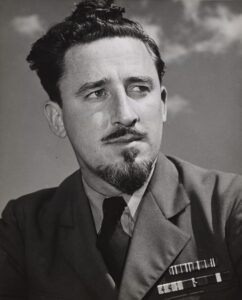
Photo: Portrait of Norman Millett Thomas
Portland Coast Guard combat artist, veteran of the Philippine, Iwo Invasions — Coast Guard combat artist Norman Millett Thomas, Chief Specialist, has returned to this country following his participation in the invasions of the Philippines and Iwo Jima. Serving aboard a Coast Guard-manned invasion transport, Coast Guardsman Thomas survived a Jap suicide plane attack which took the lives of many of his shipmates. This scene and many others have been recorded in oil, watercolor, and charcoal by Thomas, whose home is in Portland, Maine. The Coast Guard combat artist is a winner of the President’s Medal and the Pulitzer Traveling Prize.

On June 19, 1945, Thomas was transferred to Coast Guard Headquarters for assignment to temporary duty pending further assignment. He was chosen to design the Coast Guard World War II Memorial. It was not without controversy.

Thomas’s national war monument was the first of its kind to be commissioned. It depicted two Coast Guardsmen helping a wounded soldier to safety, his arms draped over their shoulders. That wounded soldier was a Black man. Thomas later talked about his experience aboard Callaway, stating that the African American gun crews inspired his work. “They were the best…” He told a reporter from the New Pittsburgh Courier that he had based the design of the monument on an illustration he had sketched at Luzon:

From the beginning I had the idea of including a Negro. I served with them. I saw them in action. I simply thought it was about time that they were honored symbolically for their services to our country in every war. The Coast Guard authorities agreed…. It is not generally known that our service is considered the most democratic with regard to the relationship between colored and white personnel.

Planned to be unveiled in 1948, controversy intervened. The memorial was to symbolically face New York Harbor and the Statue of Liberty. The fact that it featured a Black man was unacceptable to many. It was approved by the Parks Commissioner but not by the city’s Art Commission. When it was finally dedicated on May 30, 1955, The Honorable Robert Moses, who served as Parks Commissioner, spoke to the gathered crowd:

This monument, facing the Narrows and looking toward the broad Atlantic has had a checkered past. The original model was the subject of one of those murky, obscure, pointless controversies which seem to continuously beset the artistic world. As Park Commissioner, I confess I like this memorial for its sincerity and for the manifest identity of sculptor and subjects. Norman Thomas, who made the memorial, is a distinguished architect, artist and combat veteran. The idea of the memorial came to him at the Luzon beachhead where he saw two exhausted Coast Guardsmen supporting a wounded man to safety. This memorial, therefore, is not a piece of contrived romantic sentimentality. It was conceived in war and dedicated to actual heroism. Let yapping critics remember this!
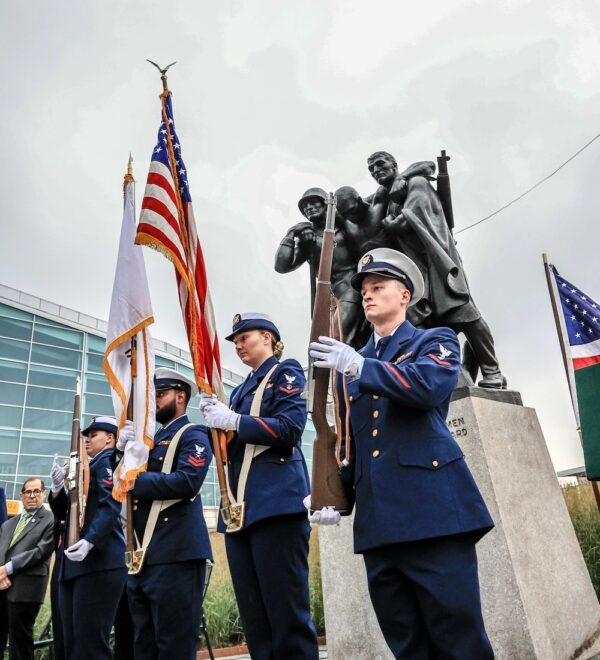
Photo: Color guard stand in front of stature.

Credit: Photo by Daniel Henry, U.S. Coast Guard Sector New York

The 2021 rededication of Thomas’s Coast Guard World War II Memorial in New York.

Thomas spent the last 40 years of his life in Mexico, where he became a devotee of Mexican painters Diego Rivera and Orozco. Not surprisingly, much of his work from that time was marked by social commentary. In 1960, he produced a satirical film entitled “El Bravo Fuerte.” It was considered so politically charged that it was banned by the Mexican government. He passed away in 1986, at age 70. The Portland [Maine] Evening Express remembered Thomas as a “brilliant, versatile artist, equally gifted as a muralist, portrait painter, and sculptor.”

In 2021, The Coast Guard Memorial designed by Norman Thomas was rededicated after being moved to a redesigned setting at The Battery. In attendance was Admiral Karl Schultz, Commandant of the Coast Guard. Also in attendance was Captain of the Port of New York, Capt. Zeita Merchant, who would soon become the first African American woman to achieve the rank of admiral. Schultz noted that visitors to the memorial “will then look out towards the water, and see Coast Guard personnel carrying on the tradition, right here in New York Harbor.” A fitting monument to those who served…a fitting monument to Norman Thomas who believed that ALL who serve should be remembered.

National Coast Guard Museum insider tip: Deck 3’s WWII exhibit will highlight some of the amazing Coast Guard Combat Art made during the war by skilled painters like Norman Thomas.