
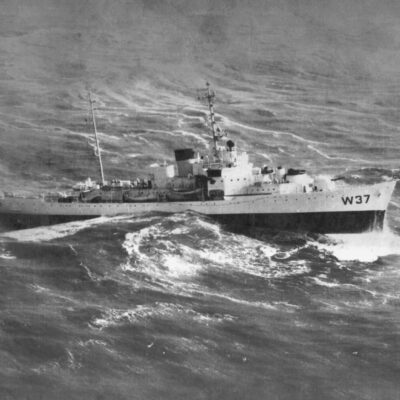
From Aztec shore to Arctic Zone; to Europe and Far East; the flag is carried by our ships; in times of war and peace.
Coast Guard Marching Song “Semper Paratus”
As the refrain of the Coast Guard marching song “Semper Paratus” indicates, the service has a global reach. Expansion into the Pacific area has taken shape over the past 180 years.
From 1790 through the 1840s, revenue cutter and lighthouse operations grew across the North American continent. The 1846 War with Mexico had the side-effect of expanding revenue cutter and lighthouse operations beyond the eastern U.S. for the first time. In 1849, Revenue Cutter C.W. Lawrence rounded Cape Horn to enter the Pacific. Lawrence was the first cutter to sail the Pacific proceeding on to Hawaii, where she enlisted the first Pacific Island crew members into the service. The Lawrence finally arrived in San Francisco, California Territory, to inaugurate cutter operations on the West Coast.
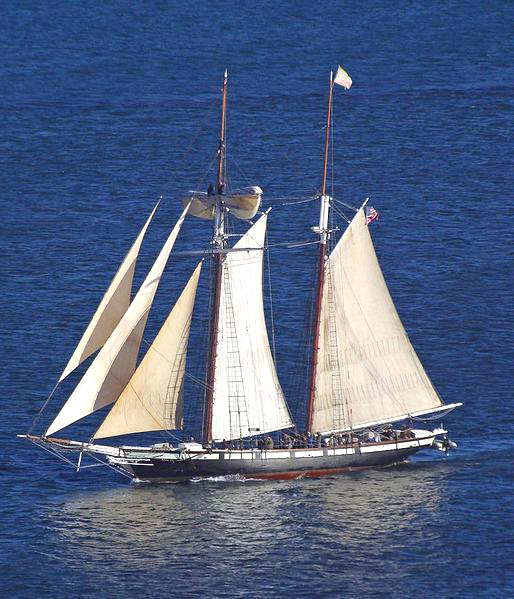
Lighthouse operations soon followed Lawrence’s arrival. By 1860, the service had revenue cutters operating under customs collectors in San Francisco, Oregon Territory (Astoria), and Washington Territory (Port Townsend). And in 1867, purchase of Alaska from Russia inaugurated West Coast cutter patrols along the Alaskan and Siberian coasts, and Bering Sea; Arctic rescue operations; the fisheries enforcement mission in Alaskan waters. By the mid-1870s, U.S. Life-Saving Service stations also began to populate the West Coast starting with the San Francisco area.
The year 1898 saw dramatic events in service history. The 1898 Overland Rescue Expedition to Point Barrow, Alaska, became the most daring and successful Arctic rescue in American history. On its 1898 voyage around the globe to serve on the West Coast, Revenue Cutter McCulloch paid first-time service visits to Indo-Pacific ports in India, Hong Kong, and Singapore. In the 1898 Battle of Manila Bay, McCulloch became the first revenue cutter to serve in combat in the Pacific. After the brief war, the U.S. annexed Guam, the Philippines, Hawaii and, in 1899, Wake Island.
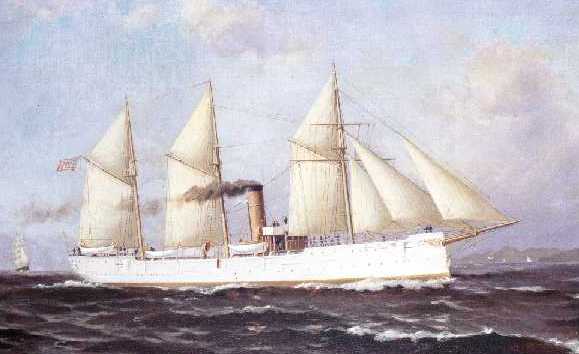
Expansion continued after the Spanish American War. In 1900, American Samoa became a U.S. territory, and, between 1903 and 1905, U.S. Lighthouse Service jurisdiction expanded to Hawaii, Midway Island, Guam and American Samoa. In 1904, Revenue Cutter Thetis became the first cutter stationed at Honolulu. For over 10 years, Thetis patrolled the Hawaiian Islands up to Midway Island as well as the Northern Pacific. And, after the Philippines came under U.S. control, the service saw a heavy influx of native Philippine recruits in the food service rates.
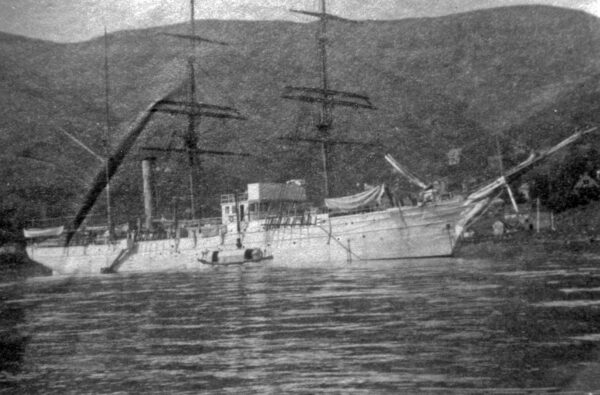
World War II sent the service around the globe to lands never visited by a cutter. The service was transferred to the Navy to support military operations with shore installations, buoy tenders, cutters, patrol craft, aircraft, weather ships, amphibious vessels, and transports. As early as 1942, Coast Guard-manned transports were visiting India and the South Pacific to deliver troops and, in some cases, evacuate civilians.
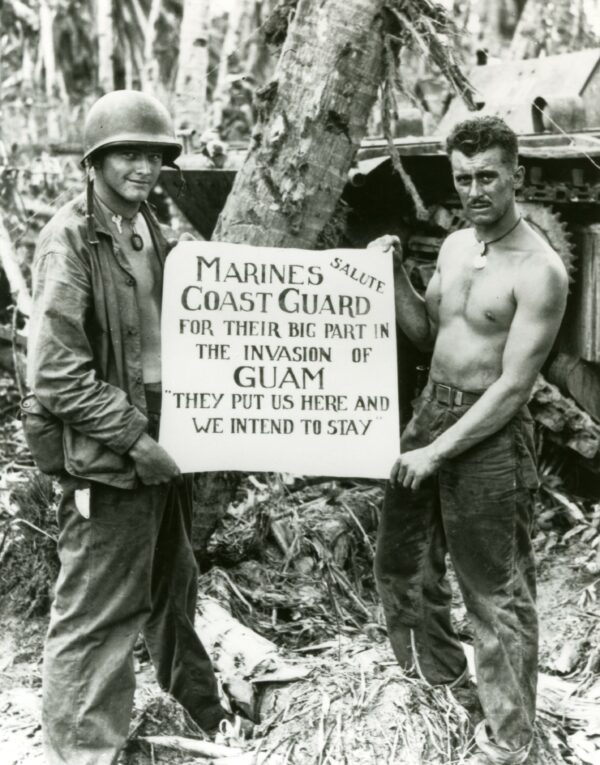
By the middle of the war, the Coast Guard began building a network of Long-Range Aids to Navigation (LORAN) stations in the Pacific theater. The LORAN system provided precise 24/7 all-weather navigation for ships and aircraft. By the spring of 1945, there were 20 LORAN stations located on various islands across the Pacific. Later in the war, the service began establishing aviation detachments, or AIRDETS, at various Pacific military airfields for SAR operations. These included Annette Island, Alaska, and Kaneohe, Hawaii. Coast Guard units and personnel served in every major campaign of the Pacific War, including Guadalcanal, Tarawa, the Philippines, Iwo Jima and Okinawa. Indeed, the service’s wartime reach prompted one service member to write music with the refrain:
I’d like to find the guy that named the Coast Guard,
And find that bit of coast he had in mind.
It wasn’t on the tanker we’d protect from submarines.
The coast at Casablanca wasn’t soft by any means,
I couldn’t find it on the beach at Attu.
I couldn’t find it at Guadalcanal.
If he thinks the name will rate it,
Where the hell can I locate it,
Oh, I’d like to find the guy that named the Coast Guard!
After the war, the Coast Guard cemented its Pacific area footprint. In 1947, Palau, the Marshall Islands, Northern Mariana Islands and the islands of Micronesia, became part of the U.S. administered Trust Territory of the Pacific Islands. In the post-war years, these territories became part of the Coast Guard’s area of responsibility administered from bases in Hawaii, Guam, Saipan and American Samoa. The service operated Ocean Station cutters stationed across the Pacific as weather ships and SAR vessels for transoceanic air travel.
For commercial navigation and U.S. defense purposes, the service continued to operate numerous LORAN stations around the Pacific, Alaska, and Far East. By 1946, these LORAN stations proved so numerous and remotely located that the service commissioned the 339-foot coastal freighter, CGC Kukui, as a re-supply and support vessel. In the 1940s and 1950s, the Coast Guard also expanded its network of AIRDETs between the U.S., Guam and the Philippines to supply LORAN stations and serve as SAR bases.
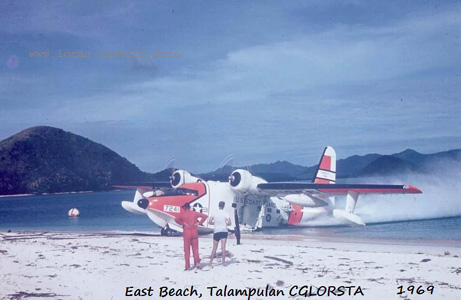
The Cold War years again required the Coast Guard to serve in certain wartime roles in the Pacific. In 1950, the Korean War brought the Coast Guard to the Korean Peninsula to operate a LORAN station and help establish a South Korean coast guard, which later became the South Korean Navy. The service also added new Ocean Station patrols across the Pacific to assist commercial vessels bound for Korea.
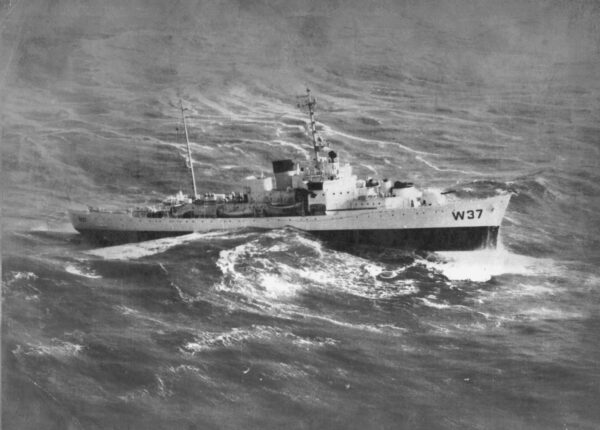
Coast Guard units also pushed farther than ever into the Arctic. Driven by supply needs of the Air Force’s Distant Early Warning (DEW) stations along Alaska’s and Canada’s northern shores, cutters Storis, Bramble and Spar made a first ever U.S. transit of the Northwest Passage in 1957, demonstrating that the military bases could be accessed by icebreaking ships. And, in 1965, the Vietnam War brought cutters, aids to navigation and shoreside Coast Guard units to Vietnam for the first time.
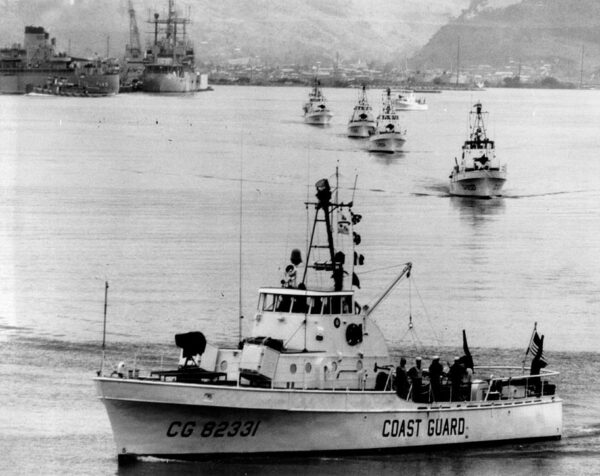
The Coast Guard’s Pacific Area traces its history back over 180 years. As the nation’s overseas territories grew in the mid-1800s, the Coast Guard’s predecessor agencies’ area of responsibility also grew. By the end of World War II, the Coast Guard operated afloat and shoreside units across the Pacific. However, in the late 20th century, funding cuts, automation and obsolescence of various technologies, saw the reduction of stations and bases in the Pacific Basin. Today, there are no more remotely located LORAN stations or AIRDETs, but the service still retains installations in American Samoa, Saipan, Guam, and Hawaii as well as domestic bases in Alaska and the West Coast.
The Coast Guard has had a long history of service to the Pacific Basin, both in times of war and peace. Thus, the region has benefitted from the service’s law enforcement, humanitarian service, environmental protection and defense readiness missions. As the World War II song goes, the Coast Guard no longer guards just the coasts!
National Coast Guard Museum insider tip: From Revenue Cutters in Alaska, to island hopping during WW2, to modern SAR operations in the Pacific Northwest, the National Coast Guard Museum will highlight the service’s presence in the Pacific across all of its exhibit decks and wings.
About the Author(s)